
Why Should I Care About Integrity?
Care allows truthfulness without making truth a weapon. It helps separate correction from condemnation: I was wrong need not mean I am without worth.
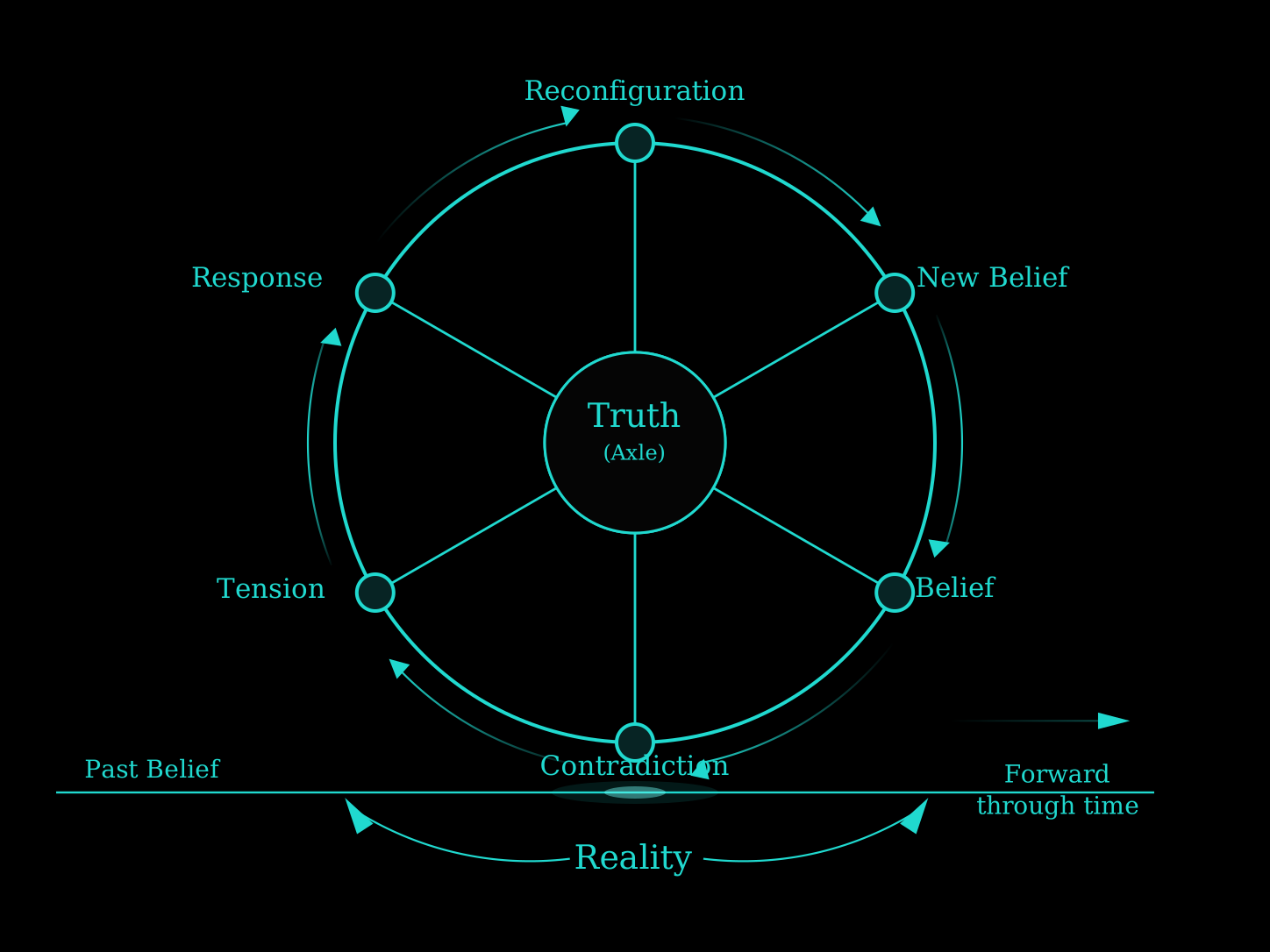
Contradiction → Integrity
Until contradiction appears, there may be no meaningful test of integrity. Integrity is willingness to remain accountable to reality when reality requires revision. Contradiction is where integrity gets tested.
Integrity requires that internal understanding remain accountable to external reality. A belief can be psychologically coherent while being factually false. Integrity therefore cannot mean merely “being consistent with myself”; it must include willingness to test oneself against what is actually there.
Care as a Weave
Care has two interwoven forms. One is care as nourishment: attention, tending, patience, protection, and conditions for growth. The other is care as enacted value: values are not merely propositions we assent to; their meaning becomes visible in response, choice, restraint, responsibility, and action. Neither form is sufficient by itself. Nourishment without values can become indiscriminate preservation—sustaining a structure simply because it exists. Values without nourishment can become abstraction or severity—declaring what matters without creating the conditions in which it can actually be lived.
How to Read the Wheel
Truth is the axle—not another stage in the process, and not a claim that we possess final truth, but the reference toward which the process is oriented. Reality is the ground against which beliefs are tested. At any instant, one stage is at the point of contact; as the wheel moves forward, that point of contact changes continuously.
Contradiction is where integrity is tested.
Integrity is not infallibility. Separating integrity from infallibility reduces personal attachment. Integrity is not the preservation of what I believe. Integrity is the preservation of my willingness to remain in relationship with reality as what I believe changes.
Once “being wrong” no longer means “being a bad, foolish, or untrustworthy person,” the system gains freedom of movement. You can say: I believed this and the evidence changed my understanding. I now believe something different.
What happens when reality pulls against what I believe?
I allow reality to test it. Integrity is our relationship to reality across time. Today’s is will become was. The question is whether the transition happens through denial, erosion, rupture, or conscious revision.
Inquiries
These questions can clarify our integrity over time:
- Am I acting with integrity?
- Am I aligning with reality or defending identity?
- Who or what am I accountable to?
- What change is possible?
- What might I still not see?
How This Fits With Fractegrity
The wheel describes the process of interrupting belief perseverance through time. Fractegrity provides seven lenses through which that process can be examined across scale and context.
- Person — move through the cycle of beliefs with integrity
- Group — respect others as they change old beliefs into new beliefs
- Institution — create systems with integrity that work with new beliefs
- Culture — honor new beliefs without erasing history so that patterns can be revealed
Integrity explores what it means to remain whole under pressure. It exposes the alignment between inner values and outward action, showing integrity not as rigidity or moral perfection, but as consistency across changing conditions.
Next threads to pull:
One: Why Should I Care About Patterns?
Two: Why Should I Care About Integrity?
Three: Why should I Care About Accountability?
Four: Why Should I Care About Alignment?