
Belief Perseverance, Reality, and the Capacity to Change
Belief perseverance can be concisely described as:
A claim: X is true.
A response: Here are two credible sources showing X is false.
A reply: I still believe X is true.
Belief perseverance is the persistence of an established belief despite clear contradictory evidence.
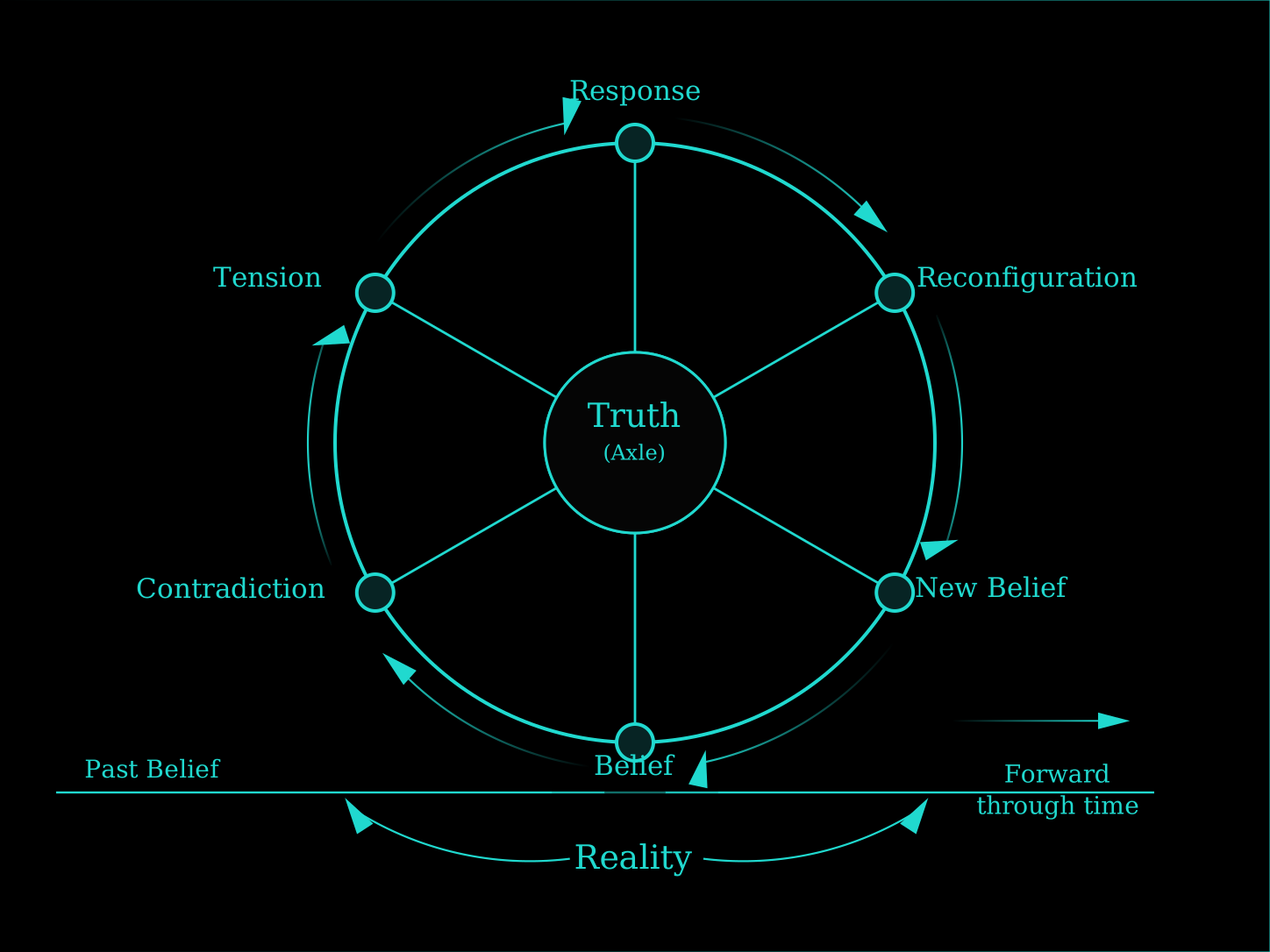
The Cycle of Beliefs
In this diagram, the wheel touches reality at only one point at any instant. The point changes continuously as the wheel moves forward. Yesterday’s contact becomes history; today’s contact becomes the present test; tomorrow brings a new point of contact.
Truth will consistently be the axle—the reference by which the structure is oriented.
Internal reality is our experienced model of what is, shaped by perception, memory, interpretation, and belief.
External reality is what exists or occurs independently of whether our internal model accurately represents it.
Truth is the orienting reference toward better correspondence between the two.
External reality and internal reality may not be congruent. But at the point of Response, we reveal how we relate to the tension between our internal model and external reality. Belief perseverance protects the existing structure of our internal reality. Integrity protects our relationship with truth and external reality. Care shapes how that relationship is lived.
A spoked wheel:
- Truth as the axle — the still center, the structural reference point
- The six stages as points around the rim — Belief, Contradiction, Tension, Response, Reconfiguration, New Belief.
- The rim as lived experience / the current working worldview — the part that keeps moving
- Rotation as change through time — the cycle continuing rather than ending
- The point of contact with the ground as present encounter with reality — the specific place where abstraction meets what is
A wheel only moves forward because one point at a time touches the ground (reality). So at any given moment, one part of the structure is where contact with reality is happening most directly. Then that point rotates onward and another takes its place.
So:
- what is currently “touching ground” is the present test
- what has already passed the contact point becomes history
- what is coming around again becomes potential revision
- motion itself becomes learning
A healthy wheel
- Truth is the axle and remains centered
- the spokes attach the continuing relationship of every stage to Truth.
- rim turns freely through the cycle of beliefs
- contact with reality is at the ground and produces forward motion through time
- the axle itself does not roll along the ground. It remains elevated, centered, and connected. Truth is not merely another stage in the cycle or just one more point on the rim. It is the organizing center by which the motion remains coherent.
An unhealthy wheel
- axle is off-center or disconnected
- spokes are weak or broken
- rim is warped
- contact with reality produces wobble, drag, or collapse—like a wheel running on a flat tire.
- Belief perseverance can preserve a distorted structure even when contact with reality reveals strain.
The Role of Integrity
Integrity protects the relationship between the structure and reality. The wheel describes process through time. Fractegrity provides seven lenses through which that process can be examined across scale and context.
Integrity asks “Is my response consistent with reality?” Integrity is not never being wrong. My integrity allowed me to change. The new belief becomes the next belief. The wheel turns again, because there is no final New Belief. There is only the newest is on its way toward was. Integrity concerns our continuing relationship with reality, not preservation of a particular belief.
Integrity is not never being wrong
Integrity is remaining open to the feedback that allows wrongness to become learning. A healthy belief pattern must be stable enough to persist and permeable enough to learn. The difference between integrity and belief perseverance is whether the discomfort is used as a reason to stop questioning or as a reason to begin questioning. Belief perseverance describes one branch of that fork. Responsive stability describes the other. Belief perseverance protects the structure. Integrity protects the relationship between the structure and reality. Sometimes preserving the structure requires denying reality. Sometimes preserving integrity requires changing the structure.
A Feedback Loop Ignored
Belief perseverance may be understood as a kind of feedback loop that is ignored. The basic pattern is typically:
- A belief forms →
- the belief becomes closely held →
- contradictory information creates stress →
- the belief either adapts or defends itself.
Using Feedback for Correction
In living systems, feedback provides signals for correction. A thermostat detects the difference between actual and desired temperature and changes its behavior. Biological systems continually respond to chemical, environmental, and mechanical signals. Communities receive feedback through experience, dissent, journalism, elections, scholarship, markets, protest, measurement, and conversation. But a system can begin to filter out corrective signals because they are disruptive. Then something subtle happens: what originally helped stabilize the system becomes the mechanism that destabilizes it.
About Care
Care takes two forms. One form is care as nourishment: attention, tending, patience, protection, conditions for growth. The other form is care as enacted value: what matters enough to shape response, choice, restraint, responsibility, and action. Nourishment without values can become indiscriminate preservation: sustaining a structure simply because it exists. Values without nourishment can become abstraction or severity: declaring what matters without creating the conditions in which it can actually be lived.
Care is an as-lived expression of declared values. Values aren’t merely propositions we assent to. Their meaning becomes visible in the response phase. Response is where professed values become as-lived values.
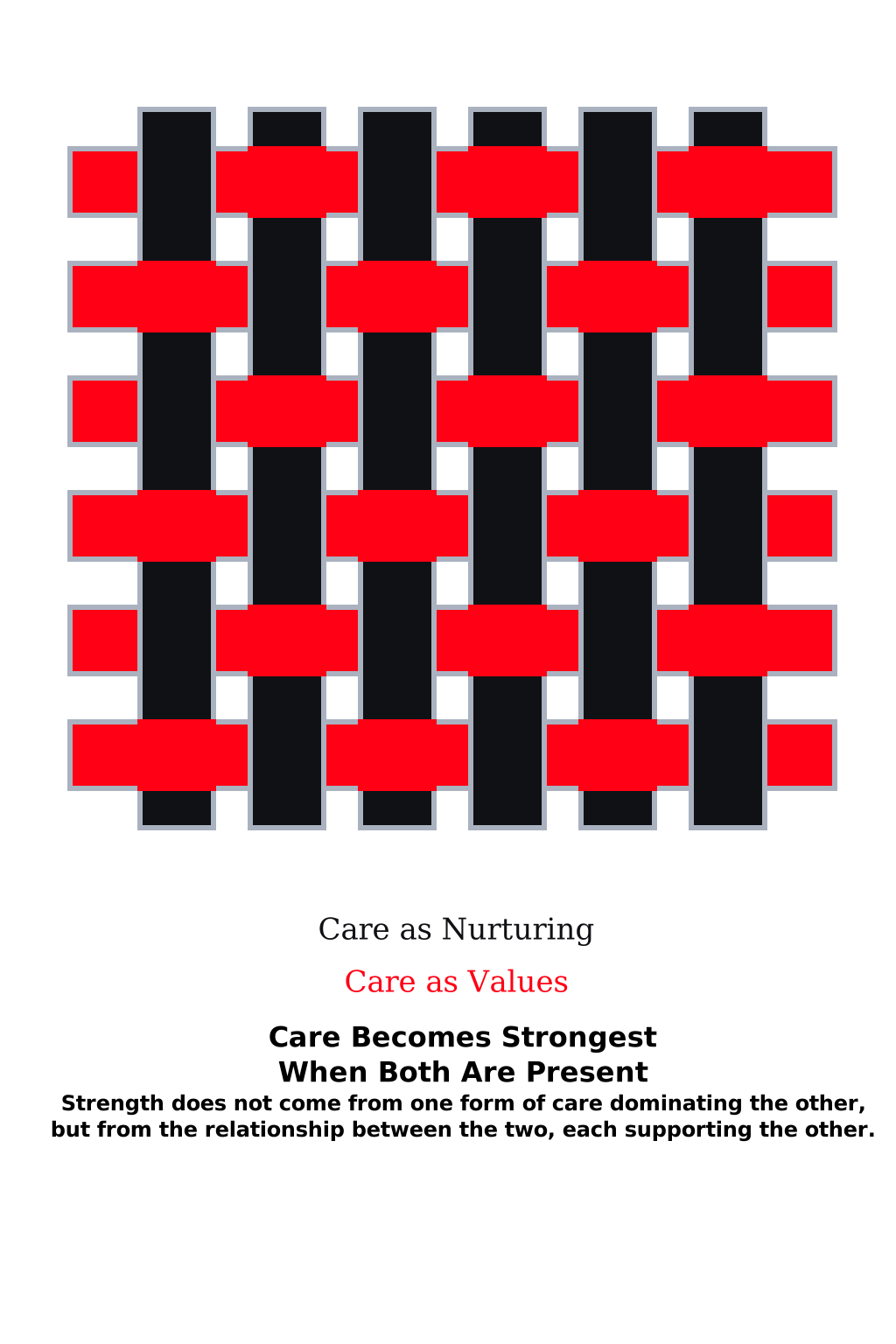
One axis is care as nourishment and the other axis is care as enacted value. Neither is sufficient by itself.
Care nourishes the capacity to remain open. Care also expresses the values that guide what we do with that openness. The weave becomes strongest when both aspects are present. Because those are independent axes, they can fail independently. A person can be well-supported and still defend a false belief. A person can also sincerely value truth and yet lack the relational or emotional conditions needed to tolerate contradiction.
Related Concepts
New Belief — Alignment and Beyond
How This Fits With Fractegrity
The wheel describes the process of interrupting the process. Fractegrity provides the lenses through which the process can be examined as it is expressed at different scales.
- Person — “Anyone who disagrees with me is biased.”
- Group — “Anyone outside the group cannot understand us.”
- Institution — “Our metrics show that our policy works,” while designing metrics that cannot reveal failure.
- Culture — “Evidence contradicting our story proves that our enemies are attacking the story.”
Belief perseverance is one of the greatest obstacles to human growth and transformation. Whether or not we cling to the past, time moves on, with or without our resistance or acceptance. Here we explore how we can recognize belief perseverance, opening up a choice as to whether or not we modify our beliefs to be more congruent with truth.
Truth orients.
Reality tests.
The wheel moves.
A stage makes contact.
The seven hubs provide perspective.
Care shapes how the encounter is lived.
Next threads to pull:
One: Why Should I Care About Patterns?
Two: Why Should I Care About Integrity?
Three: Why should I Care About Accountability?
Four: Why Should I Care About Alignment?
Five: Why Should I Care About Balance?