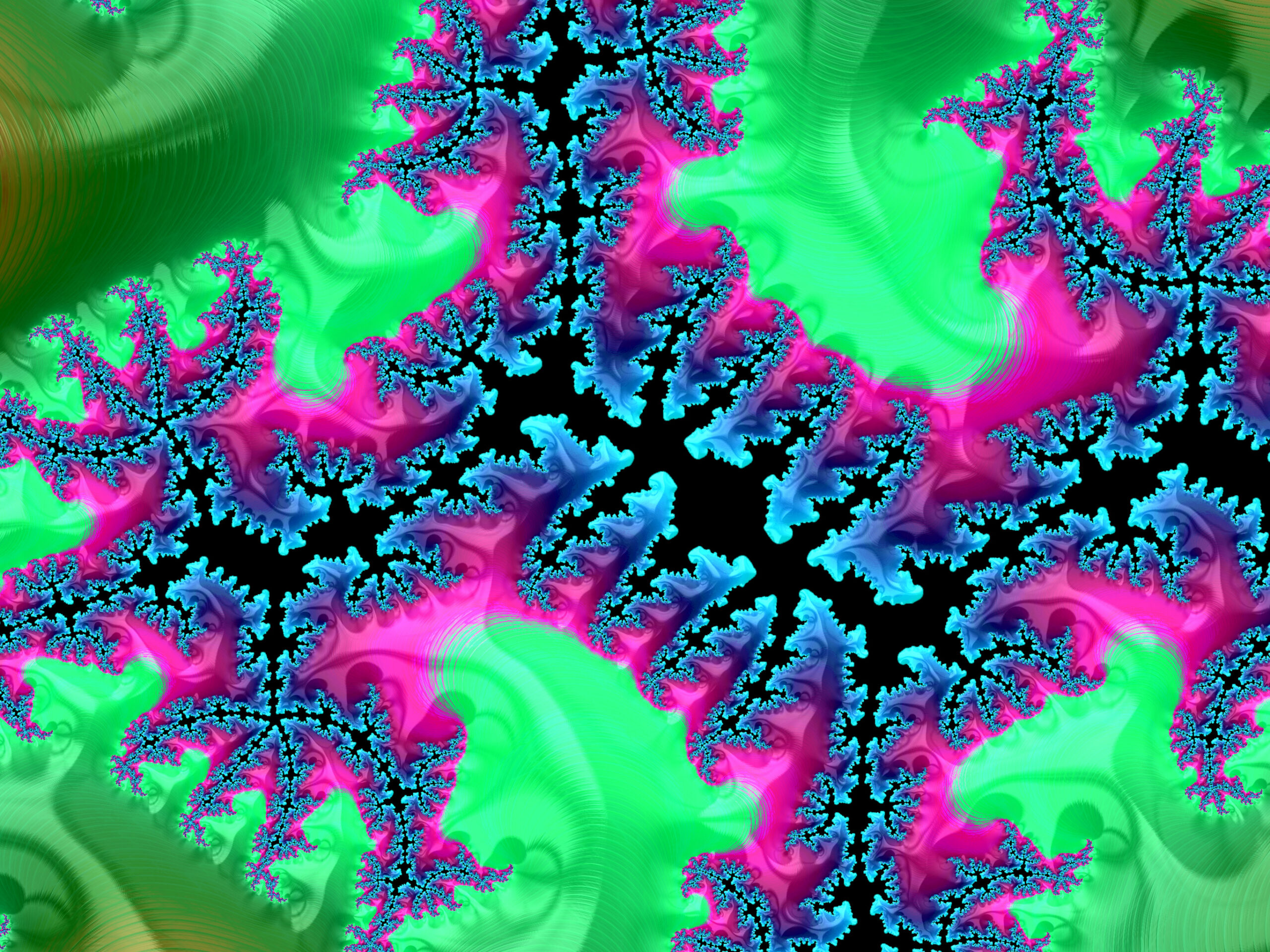
Overview of Pattern Mechanics: Fractals as Patterns That Repeat Across Scale
Fractals — Patterns That Repeat Across Scale
The Patterns hub explore how complexity emerges from simple, repeating patterns. Rather than treating scale as a hierarchy, this hub reveals scale as a continuum — where the same structural logic appears in nature, music, systems, relationships, and meaning itself.
This hub focuses on:
- self-similarity across scale
- emergence from simple rules
- repetition without redundancy
- coherence arising from recursion
Fractals here are not just mathematical objects; they are a way of seeing — a lens that reveals how wholeness is maintained even as form changes. What follows is not a lesson in mathematics, but an invitation to notice how patterns persist even as appearances shift.
It’s Fractals All the Way Down: A Geometry of Wonder
A Doorway to Wonder
Fractals are a door. They open not to somewhere else, but to a deeper level of where we already are.
What at first seems to be a shape — colorful, recursive, endlessly folding — becomes a mirror for how perception itself unfolds. Each turn, each zoom, each shimmering edge reveals that chaos and order are lovers, not enemies. What appears tangled at one scale resolves into pattern at another. Alan Watts once said that a rope seen from afar is a single flowing line, but under a microscope its fibers appear wild, directionless. The closer we look, the more we discover that disorder is simply order viewed too closely.
Mandelbrot’s Discovery
Benoit Mandelbrot gave language to this discovery when he named it fractal. He saw that nature refuses to stay smooth — that its edges are alive. Mountains, rivers, lungs, trees, lightning, coastlines — all are iterations of the same principle: self-similarity within endless difference. Between the line and the plane lies the fractional dimension, a space for the imagination to play.
Creating a Fractal
To create a fractal, one begins with a number — a point on an invisible grid — and feeds it into a simple equation. The number returns transformed, then is fed back again and again, millions of times, until the boundary between escape and belonging begins to glow. Those that stay forever near the origin become the black heart of the Mandelbrot set; those that wander outward paint its infinite skin in bands of color. To avoid computing to infinity, we set an iteration limit, a chosen moment to stop — a reminder that perception itself is iterative, that consciousness too must choose where to rest its gaze.
The resulting image is not random. It is relationship made visible — the echo of feedback between stillness and motion. Every black pixel touches every other, connected like the network of nerves or veins within the body. What we see on the screen is a digital mirror of biological truth: connection without central command, pattern without imposed design.
Yet the mathematics alone is not the whole story. The mathematics is the seed; the flowering happens in awareness. The computer, patient and tireless, performs the iterations that no human could endure. It is our telescope, our microscope, our paintbrush and loom. Through its repetition, the infinite becomes visible. What once demanded calculation now invites contemplation.
Are Fractals Art?
And in that contemplation, a question arises: Are fractals art? Some dismiss them as mere artifacts of software, as if the presence of computation disqualifies creation. But art has never been about the absence of tools; it has always been about the presence of intention. The brush, the chisel, the code — each is an extension of the same impulse to reveal relationship. To explore fractals is to collaborate with mathematics as one might improvise with sound: you set conditions, you listen, you adjust. The pattern answers back.
Playing with Fractals
This, for me, is play — not trivial, but sacred. The same kind of play that exists in music, where discipline and spontaneity become one gesture. When I play music with others, the boundaries of self loosen; stress, time, and identity suspend themselves in rhythm. What remains is coherence, shared pulse, awareness moving through form. In that state, workability becomes visible — not as a system to impose, but as a resonance that can be scaled: from the individual to the community, from the personal to the planetary.
Fractal geometry, then, becomes both metaphor and method — a model of workability that repeats at any scale. The process that supports an inner journey toward fulfillment is the same process that might sustain a thriving world. Each person, like each iteration, holds the pattern of the whole.
Chaos and Order
Fractals reveal that order and chaos are not opposites, but phases of perception. That potential and form are two sides of the same recursion. That the infinite is not “out there,” but nested within every finite moment. As the old story goes — the one Stephen Hawking loved to tell — when the philosopher asks what the world rests upon, the answer comes: “It’s turtles all the way down.”
I smile and think: No, it’s fractals all the way down.
Similarity Across Scales
- Individual — recognizing simple personal habits that repeat across daily routines
- Relational — observing recurring communication patterns in family and interpersonal dynamics
- Institutional — identifying underlying operational loops that shape organizational culture
- Societal — understanding historical and economic cycles as scale-free recursive patterns
Relationship to Other Ideas Within Fractegrity
- Self-Similarity / Scale-Free Logic — shows how micro interactions generate macro structures
- Integrity / Structural Baseline — determines whether repeating patterns maintain wholeness
- Recursion / Iteration — deepens systemic memory through repeated application of simple rules
Next Threads to Pull:
It’s Fractals All the Way Down: A Geometry of Wonder & Mandelbrot Discovery
Traces the history and beauty of fractal geometry from Benoit Mandelbrot to modern complexity theory.
How Fractals Help Us See Connections: Order, Chaos, and Perspective
Illustrates how fractal geometry reveals underlying order within seemingly chaotic natural phenomena.
Self-Similarity and the Shape of the Whole: Scale-Free Architectures
Examines how micro-level decisions mirror and shape macro-level organizational architecture.
Fractals reveal self-similarity, emergence from simple rules, repetition without redundancy, and coherence arising from recursion, seen as patterns that persist across scale in nature, music, systems, and relationships. Fractals are a way of perceiving that maintains wholeness even as forms change, inviting contemplation of how order and chaos relate through repeating patterns rather than treating scale as a strict hierarchy. Fractal thinking traces patterns from individual habits to family dynamics, organizational culture, and historical/economic cycles, emphasizing self-similarity, integrity, and recursion as organizing principles.