Introduction to the Change Hub: Transformation Under Pressure
The Change Hub examines how systems navigate transition, disruption, and breakdown without structural collapse. Utilizing the metaphor of The Fractal Crucible, this domain explores how intense environmental heat and pressure melt away hyper-rigid, obsolete structures to reveal core coherence.
In Fractegrity, change is not viewed as a threat to be resisted, but as vital signal information. Chaos is often simply a resolution problem—an indicator that a system is transitioning from one level of order to a higher, more adaptive scale.
Why Should I Care About Change?
Care affects how we react to change. The nurturing aspect of care affects how we enter the crucible and how we accompany others through it. The values aspect of care influences which changes we are willing to accept and how we choose to enact them. Transformation need not require needless destruction of what existed before.
Reconfiguration → Change
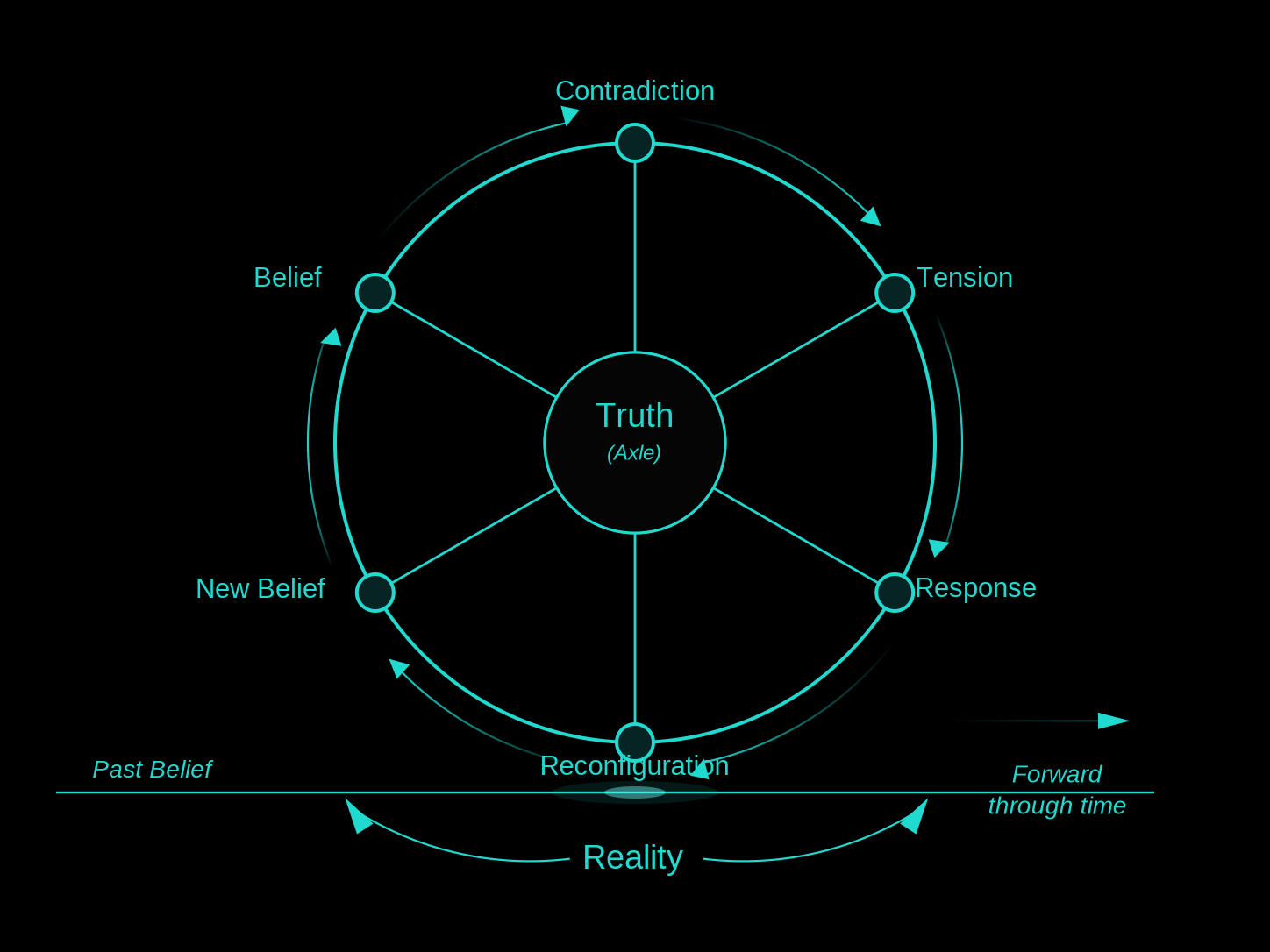
Change does not merely concern discovering contradiction or enduring tension. It concerns whether the structure is actually capable of becoming something different.
Resistance to change, including belief perseverance, follows this pattern: I believe this, then evidence arrives. I still believe this, and more evidence arrives. I still believe this. The structure refuses temporal transformation. Is cannot become was. Change depends upon our capacity to allow a belief about ourselves to migrate from present tense to past tense.
Acceptance of change follows this pattern: I was wrong. Past reality is acknowledged. I recognized it. Feedback entered awareness. I revised my understanding. The internal structure reorganized. I became more aligned with reality. Integrity increased across time.
Change is inevitable
With the passage of time—is becomes was. Today’s is will become tomorrow’s was. The question is whether the transition happens through denial, erosion, rupture, or conscious revision. This is where is can become was: “I believe” becomes “I believed”; the structure reconfigures rather than merely defending itself. Change is inevitable; conscious reconfiguration is a choice.
Inquiries
These questions can provide clarity about responding to change:
- How did the need for change arise?
- Am I acting with integrity?
- Am I aligning with reality or defending identity?
- What or who will this change affect?
- Can I embrace this change?
- What change is possible?
- What might I still not see?
Similarities Across Scales
- Micro (Individual Scale): Change manifests as personal transformation—letting go of rigid beliefs, embracing discomfort, and using crisis as a catalyst for self-discovery.
- Meso (Organizational Scale): Change operates as adaptive recalibration—transforming organizational breakdowns into opportunities for restructuring error channels and operational loops.
- Macro (Societal & Planetary Scale): Change shows up as systemic metamorphosis, where historical paradigms dissolve under economic, ecological, or social pressure to give rise to new resilient institutions.
Relationship to Other Ideas Within Fractegrity
- Relationship to Signal vs. Noise: Disruptive change generates high noise. Filtering signal from noise allows leaders to perceive the emerging order within chaotic transitions.
- Relationship to Phoenix and the Crucible: Destruction and renewal are twin phases of systemic metamorphosis. What burns away in the crucible was brittle; what survives is essential.
- Relationship to Adaptive vs. Reactive Change: Reactive change attempts to force obsolete structures back together; adaptive change aligns with systemic momentum to evolve.
Next threads to pull:
The Three-Phase Metamorphosis of Systemic Breakdown: Exposure, Domestication, Formalization
Traces how breakdown exposes hidden friction, prompting radical systemic transformation through three distinct phases.
Signal vs. Noise & Cognitive Filters: Multiscale Signal Optimization
Examines how cognitive and organizational filters separate meaningful signals from chaotic background noise during crisis.
Order, Chaos, and Perspective: Coherence at the Generative Edge
Reveals how apparent chaos is often a resolution problem that vanishes when viewed from a broader structural perspective.
Cognitive dissonance is a small crucible. Something must give: the belief, the interpretation of the evidence, the source’s credibility, or sometimes one’s sense of identity. Growth occurs when the tension becomes an opening for reorganization through change rather than merely a threat to be suppressed.