
About Resonance
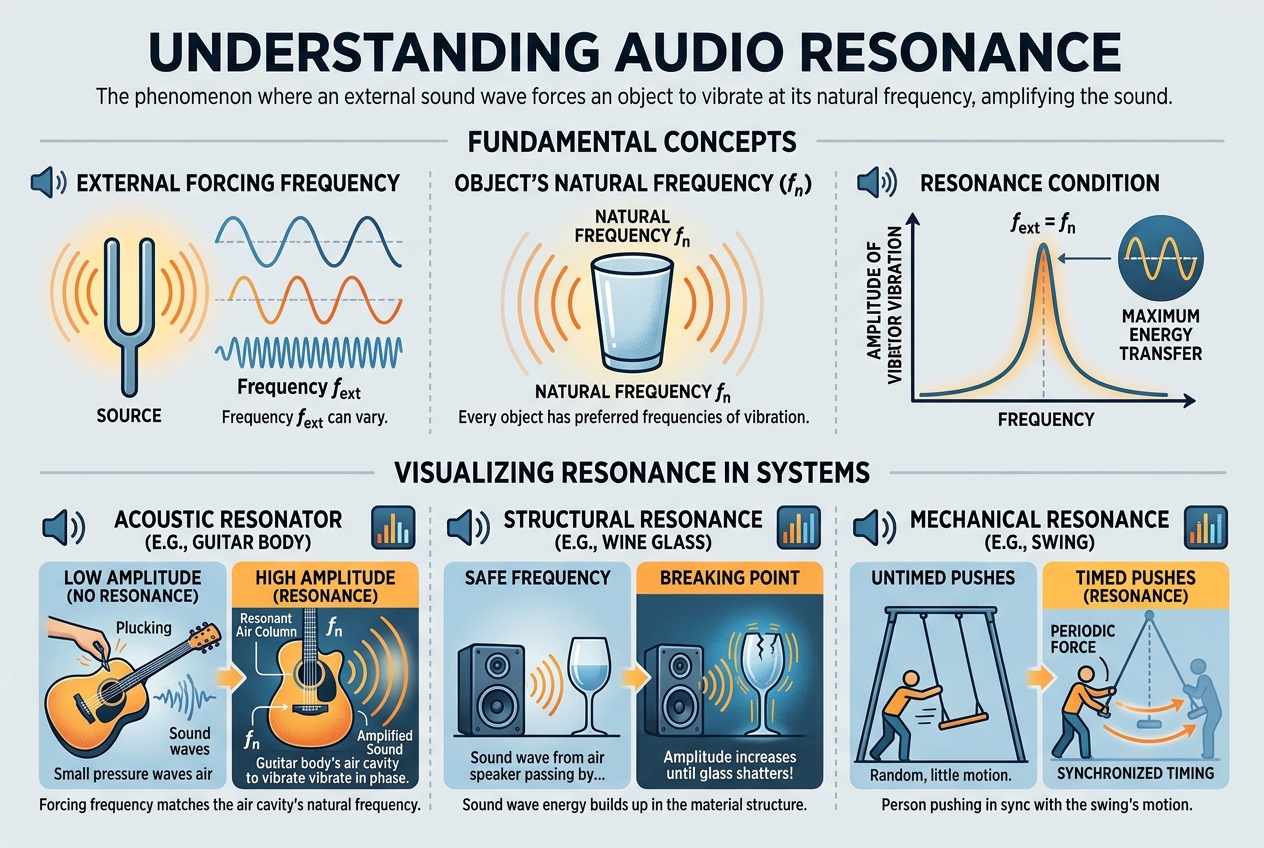
In physics, resonance is the moment when a system meets its natural frequency — when an external vibration matches an internal rhythm so perfectly that energy flows freely, almost effortlessly. A violin string held under tension begins to sing when a bow moves across it at just the right speed and pressure. A bridge, struck by rhythmic wind, can begin to sway wildly — not because the wind is strong, but because it is in sync. Resonance is not merely force meeting matter; it is frequency finding alignment.
At the heart of it is amplification through harmony. Every atom, every molecule, vibrates. When another wave of energy approaches at a matching frequency, the two do not compete — they merge, amplifying one another until a whisper becomes a roar. In this way, resonance is both delicate and powerful. It can strengthen a song, collapse a structure, or awaken a soul.
Characteristics of Feedback
Feedback occurs when the output of a system is routed back as an input. This behaves similarly across physical and human systems.
- A microphone picks up sound from a speaker, amplifies it, sends it back to the speaker, and loops indefinitely. This creates an exponential, runaway audio screech as the same frequencies are endlessly re-amplified.
- Positive feedback: A company pushes a product (output), collects customer survey data (input), and alters the product based on that data. Praise for a specific feature causes the company to double down on it, which attracts more users who like that feature, creating an accelerating trend.
- Negative Feedback: Customer complaints about a broken checkout process force the company to correct the error, dampening the problem and restoring the system to equilibrium.
Responding to Noise: System Disruption & Metamorphosis
Typically, systems try to reject noise. However, introducing or reacting to noise can radically transform a system’s output. In the mid-20th century, audio engineers viewed amplifier distortion and microphonic feedback as catastrophic failures—unwanted noise. Jimi Hendrix fundamentally altered music by leaning into this negative feedback loop. Instead of moving away from his amplifiers to stop the screech, he altered his physical distance and angle to control it. By using his guitar strings to manipulate the runaway energy, he turned chaotic, structural physical noise into sustained, expressive musical signals. He proved that reacting adaptively to systemic breakdown can establish an entirely new aesthetic paradigm.
System Breakdown Creates Noise
When a system breaks down, it stops producing its intended output and begins producing “glitches,” errors, or raw systemic friction. Most operators treat this as a failure and try to restore the system to its original state. However, reacting adaptively means treating the breakdown not as damage, but as an opening for new medium. By accepting the error as an authentic output of the system, creators can codify those failures into a structured language, creating an entirely new aesthetic paradigm.
Spectral Narrowing and Resonance
When you take a broad, chaotic spectrum of white noise and progressively restrict it using extreme filters, you focus all the system’s ambient energy into a highly restricted frequency band. As the spectrum narrows to a discrete frequency, the energy begins to stack coherently. If this concentrated energy matches the natural frequency of the system, it triggers resonance—a dramatic, self-reinforcing amplification of amplitude. Chaos becomes a a focused signal.
Social Resonance: The Power of a Declaration
Socially, resonance is the invisible current that moves through human connection. It is the moment two people, or two communities, share not only words but wavelength. A shared laugh in a crowded room, a chant that rises from a protest line, a silence that deepens when grief unites strangers — these are social harmonics, collective frequencies aligning into one wave. Each person remains distinct, yet all participate in something larger: a vibration that transcends individuality and becomes shared motion.
A human society operates much like a field of ambient noise. Millions of individuals move in disparate directions, driven by uncoordinated personal anxieties, ideas, and daily routines. A powerful social declaration (such as the Declaration of Independence or Martin Luther King Jr.’s “I Have a Dream”) acts exactly like a narrow bandpass filter on human consciousness:
- Filtering Chaos: It cuts through the day-to-day noise of society, disregarding minor disagreements and local complaints.
- Focusing Energy: It isolates a singular, core, discrete idea (e.g., liberty, equality).
- Creating Resonance: Because this specific idea matches the latent, natural values of the population, the human energy stacks up coherently. People begin acting in phase with one another, converting disorganized social noise into a powerful, resonant movement capable of rewriting history.
Art, music, and language exist because of resonance. A poem resonates when its rhythm stirs something familiar in the listener. A melody lingers not because it is complex, but because it echoes an emotional frequency already humming within us. Even disagreement can become resonance if it is met with curiosity — if each side listens for the tone beneath the argument, seeking coherence rather than conquest.
Living Resonantly in Society
To live resonantly is to sense these frequencies in the world — to attune, rather than impose. Just as an instrument must be tuned to play in harmony with an ensemble, a person must listen deeply to their surroundings to find the shared key. Resonance teaches us that strength does not come from volume, but from alignment. It is not how loud we speak, but how clearly we vibrate in truth.
In the end, resonance reminds us that we are all part of a vast orchestra of being. The universe hums, galaxies spin, atoms tremble, and somewhere within that cosmic choir, the frequencies of our hearts join the song. When we listen closely — to ourselves, to one another, to the subtle hum of the world — we remember that we do not live beside one another, but within one another’s vibration.
Similarity Across Scales
- Micro (Physical & Biological Scale): Acoustic wave iterations, molecular vibrations, and string harmonics—down to the eardrum acting as a living tensegrity membrane that continuously redraws its physical geometry to match incoming sound waves.
- Meso (Interpersonal & Relational Scale): Shared emotional wavelengths between individuals, active listening, and adaptive responses to friction—mirroring how audio engineers turn raw microphonic feedback into expressive musical signal rather than noise.
- Macro (Societal & Systemic Scale): Powerful social declarations (such as the Declaration of Independence or Martin Luther King Jr.’s “I Have a Dream”) acting as narrow bandpass filters that focus ambient, uncoordinated societal noise into coherent, resonant historical movements.
Relationship to Other Ideas Within Fractegrity
- Relationship to Feedback: Feedback loops provide the energy mechanism for resonance; positive feedback amplifies aligned frequencies, while negative feedback restores balance and dampens destructive runaway screech.
- Relationship to The Fractal Crucible & Change: Systemic breakdown and noise are not damage to be eliminated, but raw diagnostic material that can be adaptively filtered into an entirely new harmonic paradigm.
- Relationship to Structural Tensegrity: Like an eardrum membrane or a tuned violin string, resonant balance relies on relational integrity—strung under continuous, delicate tension rather than static mass.
- Relationship to The Power of Declaration: A societal declaration cuts through ambient cultural noise, isolating core values and allowing human energy to stack coherently in phase.
Next Threads to Pull:
Resonance: The Art of Vibrating in Tune Explores acoustic principles of sympathetic vibration as a model for effortless interpersonal harmony.
Feedback Analyzes feedback loops as essential learning channels that maintain systemic responsiveness and prevent runaway distortion.
Alignment as Resonance: Acoustic Harmony & Coherence Examines alignment through acoustic harmony, connecting personal values to broader systemic feedback.
Resonance occurs when external vibrations match a system’s natural rhythm, causing energy to flow and amplify—turning a subtle whisper into a roar across physical, musical, or social domains. Filtering a broad spectrum into a narrow band concentrates energy; when it matches a system’s natural frequency, it resonantly amplifies the signal. A powerful social declaration can act like a bandpass filter, isolating core ideas and aligning shared values so people act in phase, creating transformative movements.