
The Architecture of Responsibility & Accountability
Responsibility and Accountability: A Weave
Responsibility and accountability are often treated as synonyms. They are not. They are related the way intention relates to impact, or the way holding relates to being held. Responsibility begins inside. Accountability completes the loop outside.
Responsibility
Responsibility is the recognition that an action is mine to carry. It arises from awareness, capacity, position, and choice. Responsibility asks, “What am I willing and able to take care of?” It is forward-looking. It lives in intention. It can exist even when no one is watching. Responsibility without action is incomplete, but responsibility without accountability is unchecked.
Accountability
Accountability is the willingness to be answerable for what occurs. It arises from relationship, shared context, consequence, and trust. Accountability asks, “To whom, and by what measure, am I answerable?” It is backward-looking and relational. It lives in reflection and response. It requires others, even when the action was solitary. Accountability without responsibility becomes punitive. Responsibility without accountability becomes self-justifying.
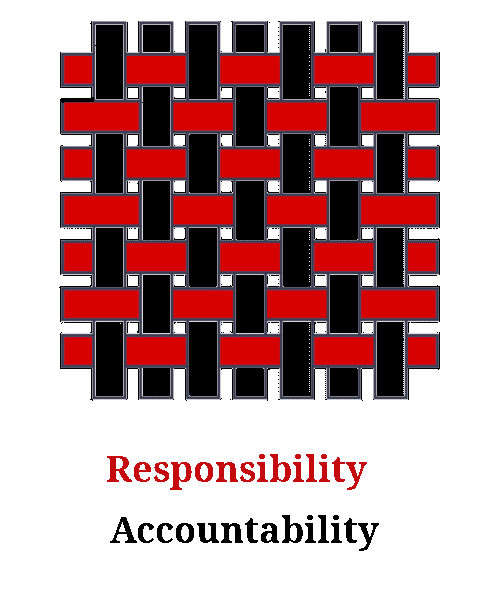
The Weave
Responsibility and accountability are not opposites. They are a weave—independent axes that must intersect. They depend on each other for strength. Responsibility is primarily internal and forward-looking: it concerns what an individual or role agrees to carry out, steward, or ensure. Accountability is primarily external and feedback-oriented: it concerns being answerable for what occurred, relative to agreed expectations and the effects on others.
An “accountability victim” in the workplace is an employee who habitually avoids taking responsibility for their actions, outcomes, or performance, often adopting a “woe is me” attitude. They operate with an external locus of control, believing they are powerless to change their circumstances and that external factors or colleagues are responsible for their failures.
Key traits and behaviors of an accountability victim in the workplace include blame-shifting and making excuses, finger-pointing, and feeling powerless and helpless.They rarely take initiative, often waiting for others to solve problems, even when they have the capacity to do so. They often feel as though things are constantly happening to them, rather than realizing they have control over their actions. Usually they exhibit resistance to feedback and growth or a refusal to learn. Because they do not acknowledge their mistakes, they rarely learn from them, causing the same problems to recur.
A typical tactic of accountability victims is known as The “4 Ds”. This includes the use of Deny (it didn’t happen), Deflect (it’s their fault), Defend (I had to), and Diffuse (you’re overreacting) to avoid responsibility.
Responsibility Without Accountability
Responsibility Without Accountability occurs when individuals or groups take on duties, make commitments, or act with genuine intent, but there is no reliable mechanism for review, feedback, or answerability. In this condition, outcomes are weakly connected to evaluation, so learning becomes optional and trust becomes fragile. Common characteristics include decision-making that is difficult to inspect or question, reliance on self-reporting rather than shared measures, “good intentions” being used as a substitute for results, and a drift from shared standards because no one can close the loop.
Accountability Without Responsibility
Accountability Without Responsibility occurs when evaluation, oversight, or consequence exists, but real ownership and agency are absent. People are “held accountable” for outcomes they cannot meaningfully influence, or accountability is used primarily as a control mechanism rather than a learning mechanism. Common characteristics include metrics and enforcement without clear ownership, blame applied downstream from decision authority, compliance demands that do not provide tools, capacity, or autonomy, fear-driven reporting and defensiveness.
Typical failure models include Punitive culture where accountability becomes synonymous with punishment. It can also include gaming the metrics where people optimize for appearing compliant rather than improving outcomes. And silencing, where risk and uncertainty go unreported because they trigger consequences.
Typical failure also includes unchecked autonomy where actors become accustomed to operating without constraint. It also may include moral certainty where responsibility becomes identity, making feedback feel like attack and burnout, when responsibility expands but accountability structures do not support it In this, the responsible party carries the full load without shared correction.
Responsibility asks: “What will I carry? Who has the agency and resources to act?” Accountability answers: “How will we verify, learn, and adjust? Who is answerable?” Restoring balance does not require reducing responsibility. It requires adding a clear feedback structure with explicit expectations, shared measures, and a routine for review that returns learning into improved commitments.
Restoring balance also requires moving accountability closer to agency: clarify roles, ensure capacity, and treat review as a learning loop. Accountability should constrain and inform action—not replace ownership.
Responsibility and accountability meet where learning occurs, trust forms, systems stabilize, and integrity becomes visible. A system with responsibility but no accountability drifts. A system with accountability but no responsibility fractures. The weave is what provides strength and stability.
What happens when reality pulls against what I believe?
Response is where professed values become as-lived values. Now that I know, what will I do?
- Accountability — what supports it? These questions can clarify accountability:
- Can accountability be possible without an agreement or promise, whether implicit or explicit?
Accountability without agreement is like measurement without a scale — awareness without orientation. An agreement, even unspoken, provides the frame through which responsibility can be perceived. Implicit promises — of care, honesty, presence — arise in every relationship, whether between people or between a person and their own conscience. Without such shared understanding, accountability dissolves into ambiguity. The “count” in accountability needs something to count on. - What good is a promise without accountability?
A promise without accountability is a note never played — potential without sound. It may inspire for a moment, but it cannot sustain harmony. Accountability gives substance to promise; it transforms intention into structure. A word kept is an act of creation; a word broken is a fracture in the pattern of trust. Promises call us upward, but accountability grounds us so we do not drift away. - How does accountability relate to the giving of one’s word?
Giving one’s word is the act of casting a thread into the future — a declaration that says, “I will meet you there.” Accountability is the act of weaving that thread into being. It is the ongoing fulfillment of what the word began. To give one’s word is to set a rhythm; to be accountable is to keep time with it. - How does accountability fall apart in the presence of blame?
Blame replaces inquiry with injury. It focuses on who is at fault rather than what has gone out of tune. Accountability seeks coherence — blame seeks correction. When blame enters, fear replaces curiosity; defense replaces reflection. In such soil, growth cannot root. True accountability is a shared commitment to restore alignment, not to assign guilt. - How is self-accountability similar and different from accountability of others?
Self-accountability is the inner compass — the silent integrity of one who keeps their promises to themselves. Accountability to others is the social mirror — the visible integrity of one who keeps their promises in relationship. They are mirrors of each other:
one ensures honesty within, the other ensures reliability without. Both require awareness; both require return.
Similarity Across Scales
- Individual — owning internal intentions (responsibility) while answering for external consequences (accountability)
- Relational — holding personal commitments to partners while welcoming shared feedback
- Institutional — clarifying role ownership while establishing transparent review loops
- Societal — fostering civic duty while holding public institutions accountable to consequences
Relationship to Other Ideas Within Fractegrity
- Integrity / Load-Bearing Ethic — anchors responsibility so it remains whole under strain
- Feedback / Reality Testing — provides the external data accountability requires
- Care / Sustained Support — ensures accountability nurtures capacity rather than extracting it
Next Threads to Pull:
Responsibility and Accountability: An Inseparable Pair & Directional Orientation
Explores responsibility and accountability as twin forces that maintain structural integrity.
Responsibility Without Accountability
Analyzes the risks of claiming responsibility without establishing transparent, verifiable feedback channels.
Intro Responsibilty
Introduces the core framework of responsibility and non-punitive accountability across scales.
Responsibility asks us to act with care. Accountability asks us to remain in relationship after we act. Neither is sufficient alone. When responsibility and accountability are woven together, failure becomes information rather than shame, success becomes shared rather than owned, and trust becomes a structural feature, not a personality trait. This is not moral perfection. It is durable participation. Accountability can be seen as a geometry of promise—how commitments are made durable without becoming harsh, how refusal can be responsibility, and how responsibility can extend beyond success, applause, or completion. It invites inquiry over certainty and care over control—so responsibility remains human while consequences remain real.