Overview of Pattern Mechanics: Fractals as Patterns That Repeat Across Scale
The Patterns Hub introduces the geometry of self-similarity that underpins natural, cognitive, and social systems. At the heart of Fractegrity is the realization that reality is structured through recurring patterns. From the branching of river deltas and pulmonary veins to the iteration of personal habits and cultural traditions, patterns are the memory and language of living systems.
Understanding pattern mechanics allows us to look past superficial noise and perceive the deep, repeating structures that govern how systems grow, adapt, and remember.
Why Should I Care About Patterns?
Care influences which patterns we attend to, which we perpetuate, and which we choose to interrupt. Pattern recognition without care could become merely prediction, categorization, or control. The underlying question becomes: What patterns have made this belief feel obvious to me?
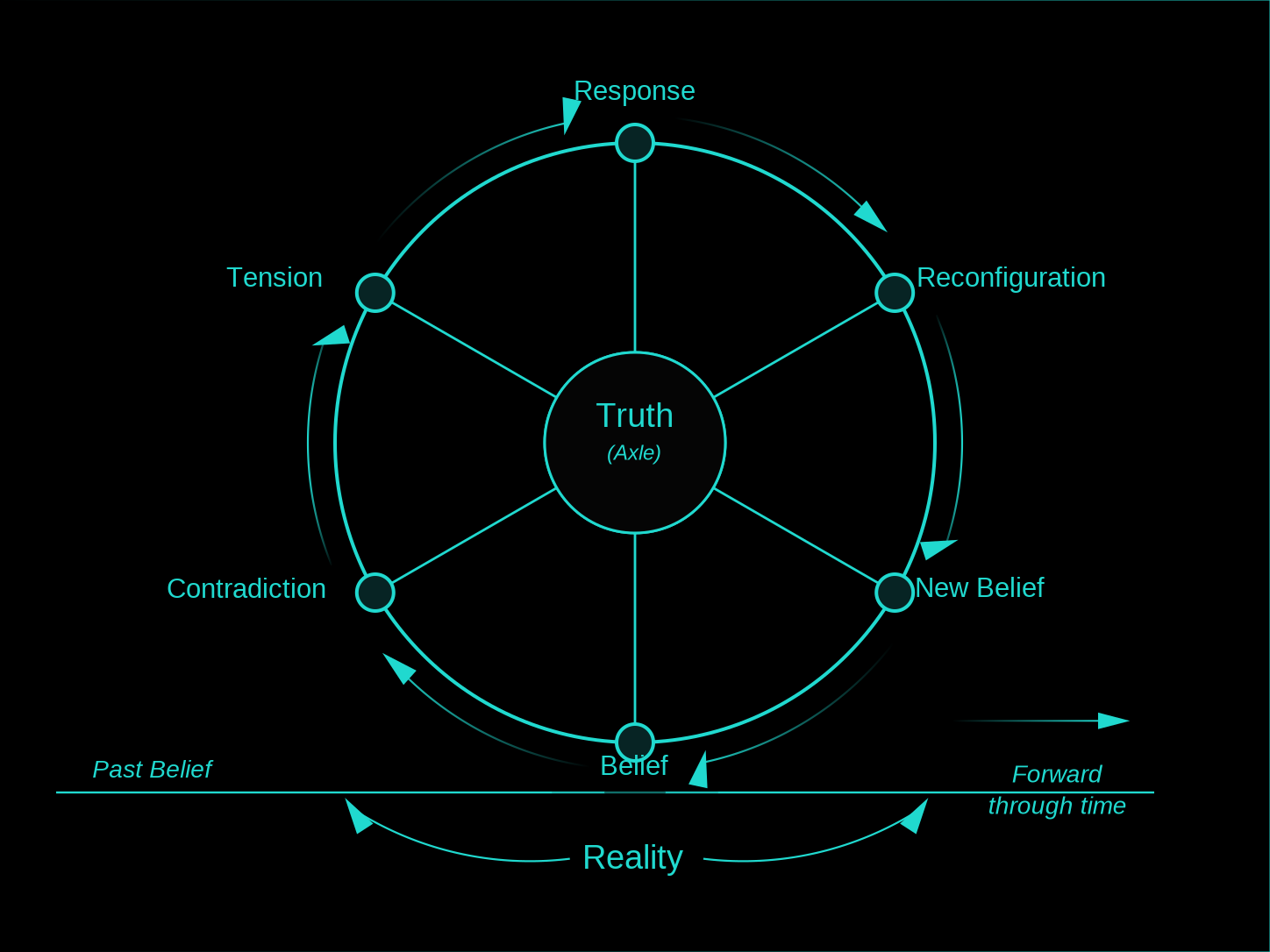
Belief → Patterns
A belief does not simply appear. It emerges from prior patterns—experience, repetition, culture, assumptions, stories, categories. “What pattern formed this belief?” These patterns, including belief perseverance, can scale up as they spread across individual, group, institutional, and cultural scales.
What happens when reality pulls against the patterns that support what I believe? I recognize the structure I have been repeating.
Inquiries
These questions can clarify the patterns that establish belief:
- What pattern am I repeating?
- Am I acting with integrity?
- Am I aligning with reality or defending identity?
- What pattern formed this belief?
- Who or what am I accountable to?
- What change is possible?
- What might I still not see?
Similarity Across Scales
- Micro (Individual Scale): Patterns manifest as personal routines, cognitive filters, and emotional loops. Our smallest daily choices form the self-similar blueprint of our character.
- Meso (Organizational Scale): Patterns govern team dynamics, communication loops, and institutional habits. Organizational culture is simply a micro-pattern repeated across multiple departments.
- Macro (Universal & Ecological Scale): Patterns reveal themselves as fractal geometry—the Mandelbrot set, spiral galaxies, coastal erosion, and economic cycles echoing the same mathematical laws across infinite dimensions.
Relationship to Other Ideas Within Fractegrity
- Relationship to Memory: Patterns are systems memory in action. A system remembers its history not by writing a narrative, but by etching repetition into physical and behavioral form.
- Relationship to Change: Systemic transformation begins with pattern recognition. You cannot recalibrate a chaotic system until you identify the repeating loops driving its momentum.
- Relationship to Signal vs. Noise: Recognizing self-similar patterns acts as an essential cognitive filter, allowing us to isolate meaningful structural signals from overwhelming environmental noise.
Next Threads to Pull:
Explores Benoit Mandelbrot’s groundbreaking discovery of self-similar geometry in natural and mathematical systems.
The Fractal Signature of Nature: Math You Can See
Patterns as Memory (Part 1: Foundational Traces)
Investigates how physical, biological, and structural systems retain historical pressure within form without conscious recording.
Cognitive Pattern Recognition
Examines how human perception deciphers sensory signals, interprets visual/auditory motifs, and avoids cognitive traps.
Patterns do not remain abstract for long. Once recognized and repeated, they begin to shape behavior, expectation, and response. What starts as perception gradually becomes practice. Over time, these repeated patterns settle into beliefs. The impacts of these beliefs are rarely sudden or dramatic; they are cumulative, embodied, and often unnoticed.