
Structural Soundness: Physical & Conceptual Mechanics
Why what holds things up matters more than what holds them together
When we speak of integrity in structures, we are often being literal. A bridge has integrity. A building either holds or it doesn’t. But the lesson structural integrity offers extends far beyond engineering. It reveals something fundamental about how systems endure — and why they fail.
Structural integrity is not about appearance, intention, or even strength in isolation. It is about whether a system can carry the loads it encounters without collapsing. Integrity is revealed not by calm conditions, but by pressure.
What Structural Integrity Is
In physical structures, integrity emerges from the relationship between three elements:
- Design — how forces are anticipated and distributed
- Materials — what the structure is made of
- Workmanship — how carefully those materials are joined
No amount of surface beauty can compensate for a compromised foundation. No elegant design can overcome poor materials. No strong materials can save careless construction. Integrity is not located in a single component. It emerges from how components relate.
The same principle applies in living systems. Integrity arises when values, intentions, actions, and consequences remain in relationship — not perfectly, but honestly. When one element is consistently misaligned, the whole becomes vulnerable.
No single element is sufficient on its own. Elegant design cannot compensate for weak materials. Strong materials cannot overcome careless construction. Good workmanship cannot save a flawed foundation. Structural integrity arises only when all three are aligned. Integrity is not located in a single component. It emerges from relationship.
Foundations Matter More Than Facades
Structures rarely fail because they look bad. They fail because something essential was compromised early, hidden, or ignored. Foundations that are rushed, substituted, or obscured create fragility that may remain invisible for years. This is why structural failure often feels sudden. The collapse is not sudden — only the visibility is.
Surface reinforcement can delay failure, but it cannot restore integrity. Cosmetic fixes do not redistribute load. They only conceal where strain is accumulating.
Load, Stress, and Honesty
Every structure encounters stress. Wind, weight, temperature, vibration, time. Integrity is not the absence of these forces. It is the capacity to hold them. A structure with integrity does not deny load.
It anticipates it. It allows forces to move through the system without concentrating destructively. When integrity is lost, stress does not disappear — it relocates. It concentrates at weak joints, brittle connections, or unacknowledged limits.
This is why integrity is inseparable from honesty. A structure that lies about its limits fails more catastrophically than one that acknowledges them early.
Integrity as Structural Soundness
What allows systems to hold under pressure
Integrity is often spoken of as a moral quality: honesty, consistency, strength of character. But before integrity is ethical, it is structural. The word itself comes from integer — whole, intact, undivided. Something with integrity can carry load without collapsing. Something without it may appear impressive, even functional, until pressure arrives.
Integrity is not what a system claims. It is what the system can sustain. Seen this way, integrity is less about virtue and more about coherence under stress. A related idea, tensegrity, describes systems designed to balance stress in a way that remains stable and sustainable. Integrity names the condition that makes such balance possible.
Integrity Is Not Rigidity
A common misunderstanding is that integrity requires firmness without flexibility. In reality, rigid systems often fail first. Structures that cannot move crack under stress. Living systems require elasticity without loss of coherence. Integrity does not mean never bending. It means bending without breaking alignment.
A system with integrity anticipates strain. It allows for adjustment. It incorporates feedback rather than resisting it. Integrity is not frozen correctness — it is adaptive wholeness.
Integrity Reveals Itself Under Load
Integrity is easiest to claim when conditions are calm. It is revealed when pressure increases. In people, loss of integrity may appear as rationalization, deflection, or inconsistency between stated values and actual behavior. In institutions, it may appear as policies that contradict purpose, or incentives that quietly reward harm. In societies, it can appear as systems that function smoothly until stress exposes what was never truly supported. In nature, it may be the difference that allows a tree to survive high winds.
Pressure does not create the problem. It exposes it. This is why integrity cannot be assessed by intention alone. It must be observed in response.
The Myth of Strength Without Structure
Strength is often mistaken for integrity. A system may appear powerful, efficient, or productive — and still be structurally unsound. Strength without integrity is brittle. It concentrates force rather than distributing it. Rigid systems often break first.
Structural integrity allows flexibility. It absorbs shock. It bends without fracture. This is why structures designed to withstand earthquakes or storms often look less imposing than those built only for static load.
Integrity is not resistance to movement. It is coherence through movement.
Repair and Maintenance Is Part of Integrity
Structures do not lose integrity because they develop cracks. They lose integrity when cracks are ignored, concealed, or treated as embarrassment rather than information. Repair is not evidence of failure. It is evidence of attention.
Maintenance, inspection, reinforcement, and redesign are not admissions of weakness. They are the practices that allow structures to endure across time and stress. Systems that cannot admit the need for repair eventually require replacement. Integrity that includes repair is resilient. Integrity that demands perfection is fragile.
The Influence of Care
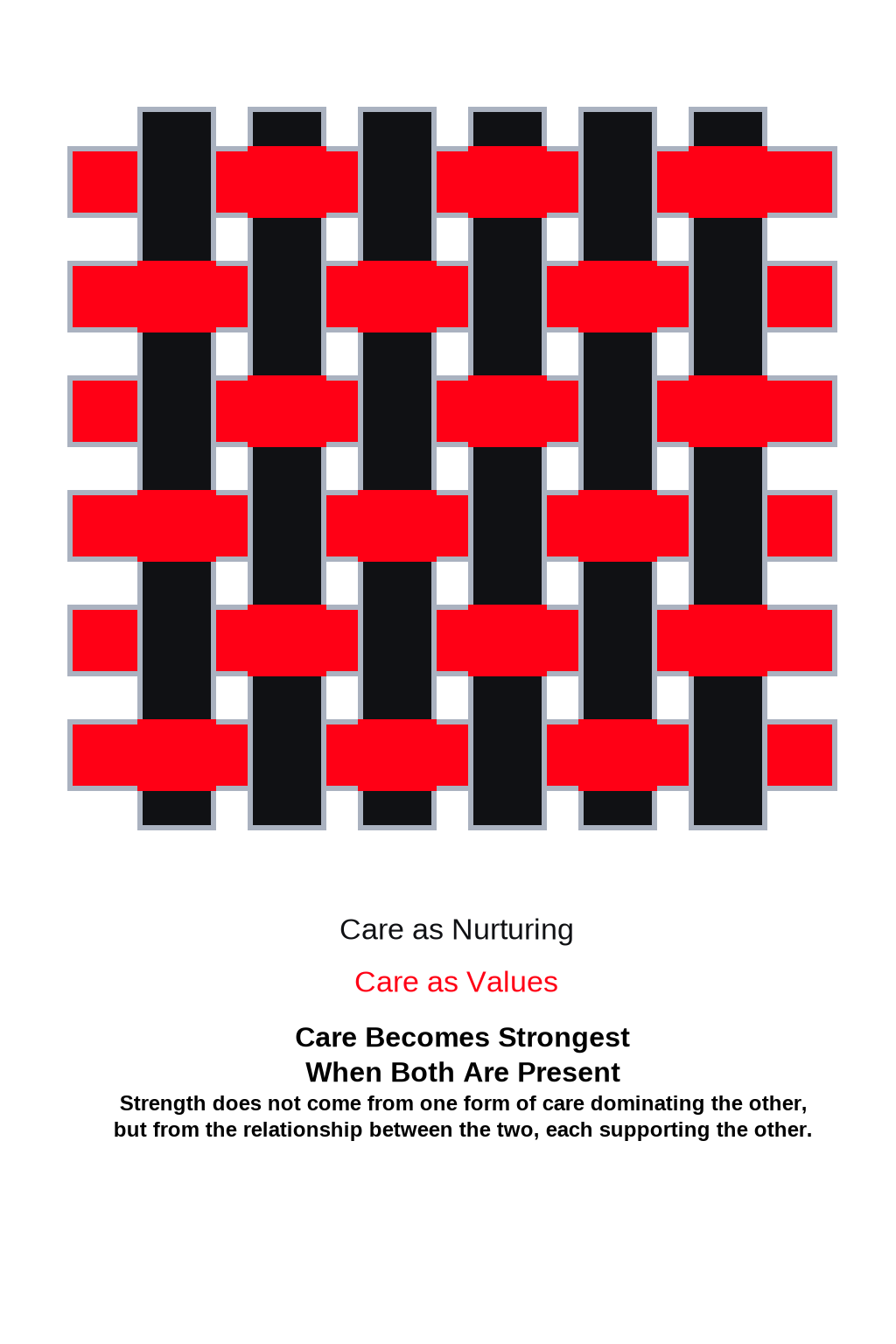
Structurally, care absorbs shock, reduces unnecessary strain, maintains continuity through stress, and preserves function during disruption. Care operates the way suspension does in a bridge or joints do in a body. It allows movement without fracture. When care is absent, stress concentrates. When stress concentrates, failure accumulates and accelerates.
Structural Integrity in Living Systems
Living systems are not built of steel or stone, but they still rely on structure. Their materials are different:
- values
- incentives
- relationships
- rules and norms
- feedback mechanisms
A system may function smoothly while its structure is compromised — just as a building may stand despite internal corrosion. Integrity is tested when conditions change.
When living systems lack structural integrity, failure often appears as:
- policies that contradict purpose
- incentives that quietly reward harm
- roles that demand behavior misaligned with values
- resilience that depends on denial or exhaustion
These systems do not fail because people are weak. They fail because load has been misrouted.
Why This Matters
Modern systems often prioritize speed, scale, and output over structure. They reward visible success while quietly externalizing stress. This produces impressive results — until conditions change.
Structural integrity asks a different question: Can this hold — not just now, but under pressure?
When integrity is treated structurally rather than morally, responsibility shifts. The work becomes less about enforcing behavior and more about designing systems that do not require fragmentation to function.
The pattern does not change, only the scale does. When integrity is present locally but absent structurally, strain accumulates. When integrity is tended consistently, resilience propagates outward. Integrity is the condition that allows all of these to remain coherent under pressure.
Similarity Across Scales
- Individual — developing personal wholeness that carries life stress without internal fragmentation
- Relational — building interpersonal relationships capable of handling disagreement without collapse
- Institutional — designing organizational architectures where incentives, values, and actions align
- Societal — maintaining democratic institutions that absorb economic and political shocks cleanly
Relationship to Other Ideas Within Fractegrity
- Fractensegrity / Dynamic Equilibrium — balances tension and compression so load is distributed
- Workmanship / Execution — realizes structural soundness through attentive craftsmanship
- The Fracrucible / Stress Test — tests whether structural integrity holds under extreme heat
Next Threads to Pull:
Integrity in Physical and Conceptual Structures: Design, Materials, Workmanship
Examines design, materials, and workmanship as the triad of structural integrity in physical and mental builds.
Integrity as Structural Soundness: Coherence Under Stress
Analyzes physical load distribution as a model for maintaining moral and conceptual soundness under stress.
Integrity in Nature: How Wholeness Endures Through Relationship
Explores biological ecosystems to show how natural systems preserve integrity through interconnected relationships.
Fractegrity — The Geometry of Awareness In Practice
Structure
Every structure begins as rhythm before it becomes shape.
Before light sketches its spirals across the sky,
before the neuron traces its filament of thought,
there is a pulse—steady, curious, recursive—
the first hint of form learning to echo itself.
Fractegrity is the awareness of this echo.
It is the integrity of the fractal:
each fragment containing the whole,
each whole depending on the coherence of its parts.
The galaxy does not know it mirrors a hurricane.
It simply moves according to balance and flow.
The hurricane does not know it mirrors the spiral of a shell,
yet each obeys a geometry older than comprehension.
That geometry is not outside us.
It is us.
A Living Mosaic
We live within a living mosaic,
where matter is rhythm slowed to visibility,
and thought is pattern accelerated to light.
Memory, music, mathematics, and meaning—
all are tessellations of the same field,
a latticework of resonance exploring itself.
Art
Art is the act of noticing this.
To create is to become aware of the recursion,
to feel the pattern recognize its own continuity.
A brushstroke, a melody, a line of code,
each is an aperture in the infinite mirror.
Through it, the universe contemplates its own possibilities.
Through it, potential condenses into presence.
Consciousness
Consciousness, then, is not confined within the skull.
It is the luminous tension between observer and observed,
between silence and the first vibration.
The brain may be the receiver,
but awareness is the field—the space in which both signal and instrument arise.
Like gravity, it cannot be seen directly;
it reveals itself only through curvature,
through the bending of experience toward meaning.
Living with Fractegrity
To live fractegrally is to recognize harmony in motion.
It is to see that division is pattern seen too closely,
that contradiction is rhythm caught mid-beat.
What appears separate is only phase difference—
the same wave refracted through time.
Integrity is not rigidity; it is coherence.
It allows for improvisation.
It honors dissonance as a necessary interval
in the chord of becoming.
Ah, Music!
And music—our human music—
is the whisper of this geometry made audible.
Every frequency a filament of the infinite,
every rhythm a record of change.
When we play, we do not create vibration;
we join it.
Participation
We participate in the grammar of the cosmos.
Our melodies are brief translations
of a universal syntax that has no need for words.
Fractegrity invites us to remember:
that art, science, and spirit are not different pursuits,
but the same exploration seen through different harmonics.
To study the pattern is to praise it.
To play within it is to belong to it.
To listen—truly listen—is to hear infinity
folding itself back into zero
so that the song may begin again.
Integrity is not a badge to be worn. It is a structure to be lived inside. It is revealed not by what systems promise, but by what they can carry without breaking. When integrity is tended as structure rather than image, systems gain the ability to adapt without self-betrayal. They bend, repair, and endure — not because they are rigid, but because they remain whole. Structures fail quietly long before they fail visibly. Integrity is not what makes collapse impossible — it is what makes collapse unlikely, detectable, and repairable.