
Responsibility Without Accountability
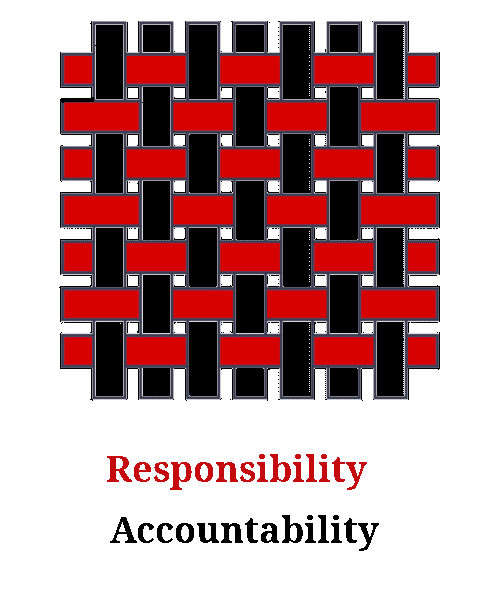
Why Responsibility and Accountability Are a Weave
Responsibility Without Accountability
Responsibility Without Accountability occurs when individuals or groups take on duties, make commitments, or act with genuine intent, but there is no reliable mechanism for review, feedback, or answerability. In this condition, outcomes are weakly connected to evaluation, so learning becomes optional and trust becomes fragile. Common characteristics include decision-making that is difficult to inspect or question, reliance on self-reporting rather than shared measures, “good intentions” being used as a substitute for results, and a drift from shared standards because no one can close the loop.
Accountability Without Responsibility
Accountability Without Responsibility occurs when evaluation, oversight, or consequence exists, but real ownership and agency are absent. People are “held accountable” for outcomes they cannot meaningfully influence, or accountability is used primarily as a control mechanism rather than a learning mechanism. Common characteristics include metrics and enforcement without clear ownership, blame applied downstream from decision authority, compliance demands that do not provide tools, capacity, or autonomy, fear-driven reporting and defensiveness.
Failures of Responsibility and Accountability
Typical failure models include Punitive culture, where accountability becomes synonymous with punishment. It can also include gaming the metrics where people optimize for appearing compliant rather than improving outcomes. And silencing, where risk and uncertainty go unreported because they trigger consequences.
Typical failure also includes unchecked autonomy where actors become accustomed to operating without constraint. It also may include moral certainty where responsibility becomes identity, making feedback feel like attack and burnout, when responsibility expands but accountability structures do not support it In this, the responsible party carries the full load without shared correction.
A practical reference
Responsibility asks: “What will I carry? Who has the agency and resources to act?” Accountability answers: “How will we verify, learn, and adjust? Who is answerable?” Restoring balance does not require reducing responsibility. It requires adding a clear feedback structure with explicit expectations, shared measures, and a routine for review that returns learning into improved commitments.
Restoring balance also requires moving accountability closer to agency: clarify roles, ensure capacity, and treat review as a learning loop. Accountability should constrain and inform action—not replace ownership.
Similarity Across Scales
- Individual: Taking on personal duties and commitments with genuine intent, but relying on self-reporting or good intentions without external answerability, causing trust to become fragile.
- Relational: Experiencing expanded duties or relational expectations without supportive review structures, leading to unshared load, defensive isolation, or burnout.
- Institutional: Operating with decision-making that is difficult to inspect, or conversely imposing metrics without ownership, resulting in punitive blame, silenced risks, and gamed compliance metrics.
- Societal Scale: Disconnecting present actions and policy decisions from long-term evaluation, externalizing costs and risks onto unrepresented future generations.
Relationship to Other Ideas Within Fractegrity
- Relationship to Responsibility and Accountability: A Weave: Responsibility without accountability becomes self-justifying and unchecked, while accountability without responsibility becomes coercive and punitive; true systemic stability requires weaving both axes together into an active feedback loop.
- Relationship to Accountability Without Condemnation: Restoring balance requires shifting from punitive blame and shame to diagnostic feedback, ensuring that error signals trigger systemic repair rather than fear responses.
- Relationship to Care as Structural Support: Care serves as the essential infrastructure that keeps responsibility survivable and accountability non-extractive, protecting individuals from carrying unshared operational stress.
- Relationship to Boundary Stewardship & Refusal: Refusal functions as an essential protective boundary when authority, capacity, or tools are absent, preventing unchecked autonomy or overextension under pressure
Next Threads to Pull:
Intro Responsibilty
Introduces the core framework of responsibility and non-punitive accountability across scales.
The Architecture of Responsibility & Accountability
Details structural design patterns for embedding responsibility and non-condemnatory feedback into organizations.
Responsibility and Accountability: An Inseparable Pair & Directional Orientation
Explores responsibility and accountability as twin forces that maintain structural integrity.
People take on duties with good intent, but there’s no reliable review or answerability, making learning optional and trust fragile. There is evaluation and consequence without real ownership, so outcomes are influenced by others and learning is secondary to control. Failures include punitive culture, gaming the metrics, silencing risk, unchecked autonomy, moral certainty, and burnout from unshared correction. Restoring balance needs a clear feedback structure, shared measures, and a review routine that turns learning into improved commitments.