
Responsibility and Accountability: An Inseparable Pair & Directional Orientation
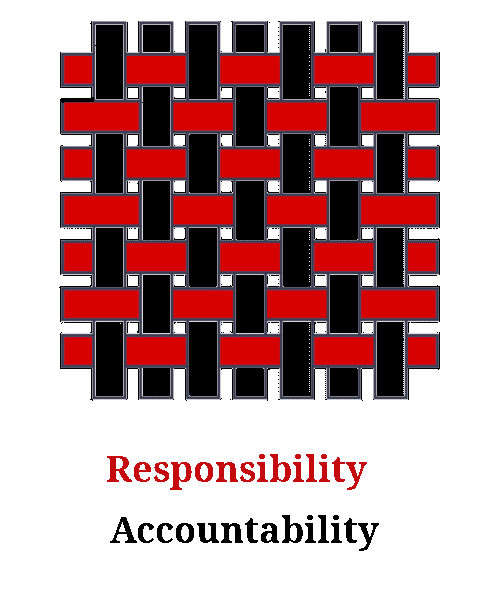
Responsibility and Accountability — An Interdependent Weave
Responsibility and accountability are often treated as synonyms. They are not. They are related the way intention relates to impact, or the way holding relates to being held. Responsibility begins inside. Accountability completes the loop outside. Responsibility and accountability are not opposites. They are a weave—independent axes that must intersect. They depend on each other for strength. Responsibility is primarily internal and forward-looking: it concerns what an individual or role agrees to carry out, steward, or ensure. Accountability is primarily external and feedback-oriented: it concerns being answerable for what occurred, relative to agreed expectations and the effects on others.
Responsibility and accountability meet where learning occurs, trust forms, systems stabilize, and integrity becomes visible. A system with responsibility but no accountability drifts. A system with accountability but no responsibility fractures. The weave is what provides strength and stability.
Responsibility without accountability often becomes self-referential: intentions substitute for results, and confidence can drift into unchecked autonomy. Accountability without responsibility often becomes coercive: blame or control is applied where agency and ownership are absent.
The goal is not “more” of one term, but a stable coupling. Responsibility provides initiative and direction. Accountability provides grounding, learning, and trust maintenance. When paired, they form a functional feedback loop: responsibility → action → impact → accountability → learning → refined responsibility.
This loop is the mechanism by which systems improve without relying on perfect foresight. It turns mistakes into information, and it keeps power tethered to consequences. The pairing of responsibility and accountability is meant to function as a compass, not a treatise. Responsibility points forward toward commitment and care, accountability points back toward learning and relationship. When those two directions are clear, the rest tends to fall into place on its own.
Responsibility
Responsibility is the recognition that an action is mine to carry. It arises from awareness, capacity, position, and choice. Responsibility asks, “What am I willing and able to take care of?” It is forward-looking. It lives in intention. It can exist even when no one is watching. Responsibility without action is incomplete, but responsibility without accountability is unchecked.
Accountability
Accountability is the willingness to be answerable for what occurs. It arises from relationship, shared context, consequence, and trust. Accountability asks, “To whom, and by what measure, am I answerable?” It is backward-looking and relational. It lives in reflection and response. It requires others, even when the action was solitary. Accountability without responsibility becomes punitive. Responsibility without accountability becomes self-justifying.
The Weave
Responsibility and accountability are not opposites. They are a weave—independent axes that must intersect. They depend on each other for strength. Responsibility is primarily internal and forward-looking: it concerns what an individual or role agrees to carry out, steward, or ensure. Accountability is primarily external and feedback-oriented: it concerns being answerable for what occurred, relative to agreed expectations and the effects on others.
Responsibility and accountability meet where learning occurs, trust forms, systems stabilize, and integrity becomes visible. A system with responsibility but no accountability drifts. A system with accountability but no responsibility fractures. The weave is what provides strength and stability.
An Inseparable Weave
Responsibility asks us to act with care. Accountability asks us to remain in relationship after we act. Neither is sufficient alone. When responsibility and accountability are woven together, failure becomes information rather than shame, success becomes shared rather than owned, and trust becomes a structural feature, not a personality trait. This is not moral perfection. It is durable participation.
Responsibility Without Accountability occurs when individuals or groups take on duties, make commitments, or act with genuine intent, but there is no reliable mechanism for review, feedback, or answerability. In this condition, outcomes are weakly connected to evaluation, so learning becomes optional and trust becomes fragile. Common characteristics include decision-making that is difficult to inspect or question, reliance on self-reporting rather than shared measures, “good intentions” being used as a substitute for results, and a drift from shared standards because no one can close the loop.
Accountability Without Responsibility occurs when evaluation, oversight, or consequence exists, but real ownership and agency are absent. People are “held accountable” for outcomes they cannot meaningfully influence, or accountability is used primarily as a control mechanism rather than a learning mechanism. Common characteristics include metrics and enforcement without clear ownership, blame applied downstream from decision authority, compliance demands that do not provide tools, capacity, or autonomy, fear-driven reporting and defensiveness.
Typical failure models include Punitive culture where accountability becomes synonymous with punishment. It can also include gaming the metrics where people optimize for appearing compliant rather than improving outcomes. And silencing, where risk and uncertainty go unreported because they trigger consequences.
Typical failure also includes unchecked autonomy where actors become accustomed to operating without constraint. It also may include moral certainty where responsibility becomes identity, making feedback feel like attack and burnout, when responsibility expands but accountability structures do not support it In this, the responsible party carries the full load without shared correction.
Similarity Across Scales
- Individual — owning internal intentions (responsibility) while answering for external consequences (accountability)
- Relational — holding personal commitments to partners while welcoming shared feedback
- Institutional — clarifying role ownership while establishing transparent review loops
- Societal — fostering civic duty while holding public institutions accountable to consequences
Relationship to Other Ideas Within Fractegrity
- Integrity / Load-Bearing Ethic — anchors responsibility so it remains whole under strain
- Feedback / Reality Testing — provides the external data accountability requires
- Care / Sustained Support — ensures accountability nurtures capacity rather than extracting it
Next Threads to Pull:
The Architecture of Responsibility & Accountability
Details structural design patterns for embedding responsibility and non-condemnatory feedback into organizations.
Responsibility Without Accountability
Analyzes the risks of claiming responsibility without establishing transparent, verifiable feedback channels.
Intro Responsibilty
Introduces the core framework of responsibility and non-punitive accountability across scales.
Responsibility is internal and forward-looking, about what I am willing and able to carry out; accountability is external and feedback-oriented, about being answerable for what occurred relative to expectations. Responsibility and accountability are independent axes that must intersect to provide strength and stability, forming a functional feedback loop. When paired, responsibility leads to action and accountability provides learning, grounding, and trust maintenance, enabling systems to improve without perfect foresight. Responsibility without accountability can become self-referential, while accountability without responsibility can become punitive; both require the other to avoid drift or fracture.