
Introduction to the Balance Hub: Tensegrity & Dynamic Equilibrium
The Balance Hub reframes balance away from static, motionless immobility toward dynamic equilibrium. In living systems, balance is never achieved by locking elements into rigid positions. True balance is an active, responsive process maintained through continuous tension and dynamic relationship.
Utilizing Buckminster Fuller’s principle of Tensegrity (tensional integrity), this hub explores how structures—whether physical bridges, human bodies, or constitutional democracies—achieve extraordinary strength by balancing continuous tension with isolated compression.
Why Should I Care About Balance?
Care makes room for competing needs and tensions without demanding that one side simply defeat the other. It supports the capacity to hold tension long enough to discover a more coherent configuration.
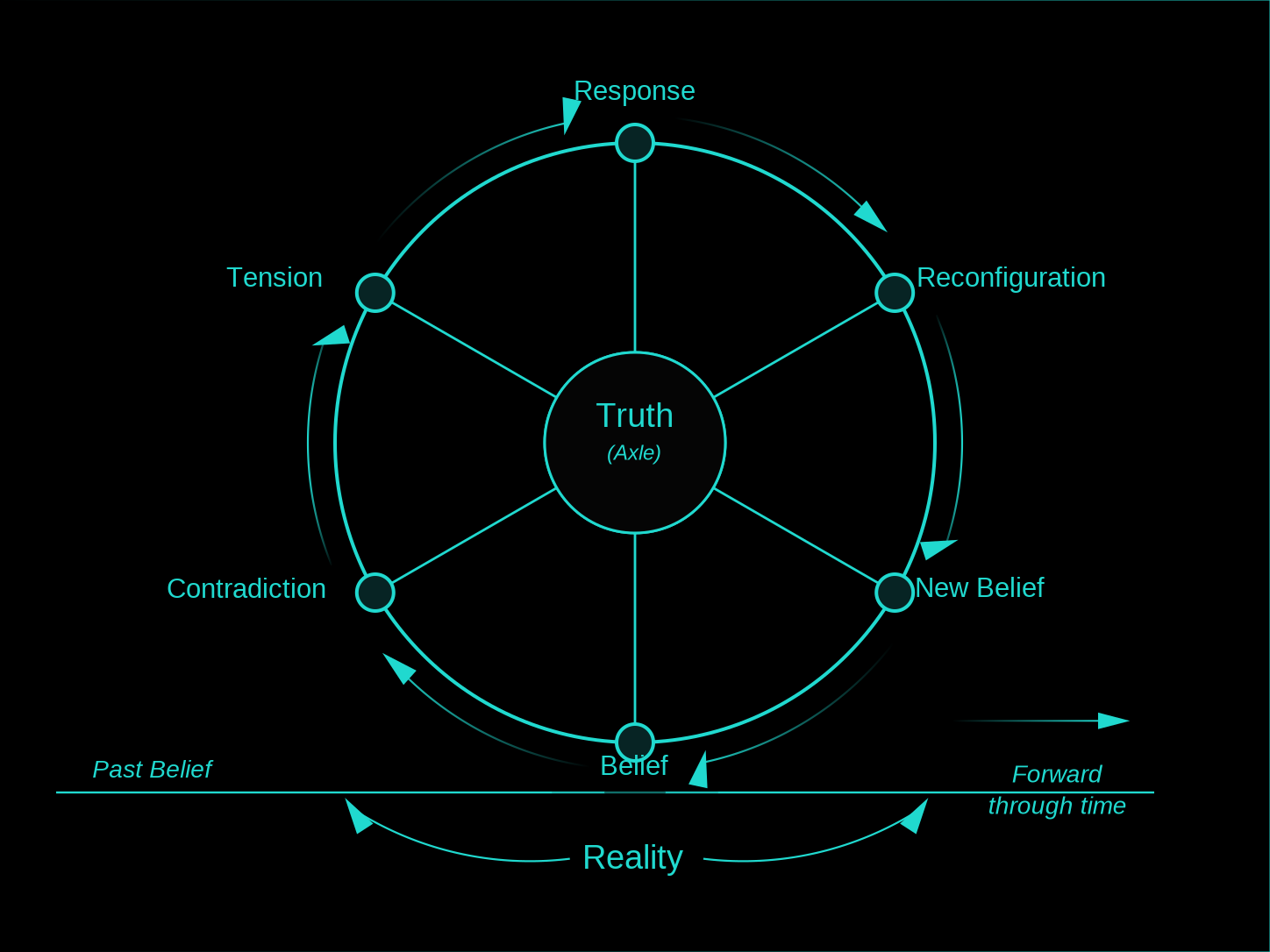
Tension → Balance
Healthy cognition needs both stability and adaptability; too much rigidity turns durability into impermeability and leaves the structure vulnerable to fracture. Balance is the capacity to hold that tension long enough for meaningful response and reconfiguration to occur.
At the stage of Tension, one could ask: Am I tolerating the tension or escaping it? Contradiction produces tension. A healthy structure neither collapses under that tension nor becomes so rigid that it cannot respond.
With balance, some perseverance is necessary. We could not function if every new claim immediately overturned our worldview. Healthy cognition requires both stability and adaptability. The problem is not having durable beliefs; it is becoming so rigid that durability becomes impermeability.
What ideally happens when reality pulls against what I believe? I tolerate the tension without either collapsing or becoming rigid.
Inquiries
These questions can clarify the tension that occurs with contradiction:
- What tensions sustain this contradiction?
- Am I acting with integrity?
- Am I aligning with reality or defending identity?
- Can I tolerate this tension?
- What change is possible?
- What might I still not see?
Similarity Across Scales
- Micro (Individual Scale): Balance operates as internal poise under stress. It is the ability to maintain flexibility without losing orientation, leaning into tension without breaking.
- Meso (Relational & Institutional Scale): Balance functions as relational tensegrity—where interpersonal differences and healthy push-pull dynamics create mutual stability rather than destructive conflict.
- Macro (Societal & Governance Scale): Balance shows up in constitutional checks and balances, market equilibriums, and ecological stewardship, where opposing forces preserve systemic coherence without coercing uniformity.
Relationship to Other Ideas Within Fractegrity
- Relationship to Integrity: Tensegrity is structural integrity in motion. A system maintains wholeness by allowing its parts to flex and shift load dynamically.
- Relationship to Accountability: Relational balance requires non-condemnatory accountability. When load increases, tension must be distributed across the entire network rather than concentrated as blame on a single node.
- Relationship to Orientation: Balance requires constant reorientation. True equilibrium is not standing still; it is navigating momentum with awareness.
Next threads to pull:
Tensegrity — The Hidden Balance of the Constitution
Applies Buckminster Fuller’s tensegrity principles to governance, democratic institutions, and constitutional checks and balances.
Dynamic Balance: Equilibrium in Motion
Explores how living organisms and adaptive systems maintain stability through continuous adjustment rather than fixed rigidity.
Between Standing and Leaning: Independence and Interdependence
Analyzes the delicate balance between individual autonomy and mutual systemic support across human relationships.
Balance is the capacity to hold that tension long enough for meaningful response and reconfiguration to occur. This is responsive stability: incorporating change in response to evidence without losing coherence.