
Introduction to the Cohesion Hub: Alignment & Resonance Across Scales
The Cohesion Hub explores how internal orientation and shared vibration create effortless alignment and resonance across personal, relational, and systemic scales. Cohesion in systems is typically referred to as alignment; cohesion in physics is referred to as resonance.
Rather than forcing compliance through top-down pressure or rigid enforcement, cohesion in Fractegrity is understood as sympathetic resonance—vibrating in tune with core principles and environmental feedback.
When an individual or organization achieves cohesion, action flows naturally with minimal friction. When misalignment occurs, it serves as diagnostic information guiding us back to coherence.
Why Should I Care About Cohesion, Resonance and Alignment?
Care keeps alignment from becoming conformity. Genuine alignment can preserve difference while seeking resonance and relationship.
What happens when reality pulls against what I believe?
When evidence, belief, language, and action correspond reasonably well, there is alignment. I adjust my understanding toward what is. Belief perseverance creates misalignment: our internal model and external reality begin to diverge
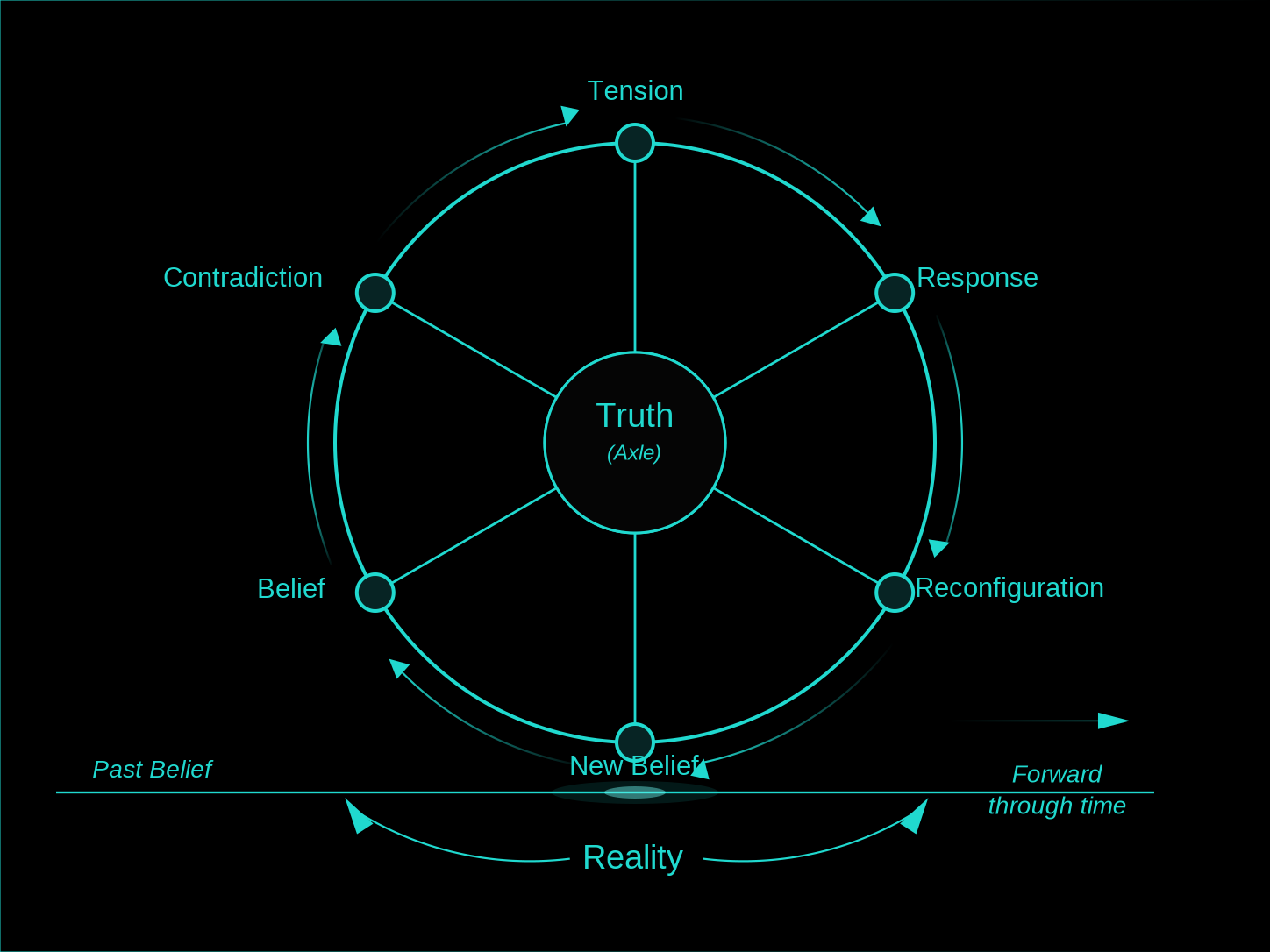
New Belief → Alignment
Alignment tests whether the reconfigured internal model corresponds more closely with reality. A new belief ideally enables movement toward better correspondence with what reality presently allows us to understand—not because the new belief is now truth, but because it must itself encounter reality. “New belief” should not become a triumphal endpoint because the wheel continues to turn!
With alignment, revision is movement toward better correspondence between our internal model and reality. We do not acquire truth; we become more aligned with what reality presently allows us to understand.
Inquiries
These questions can help clarify the alignment of a new belief:
- What am I aligning myself with?
- Am I acting with integrity?
- Am I aligning with reality or defending identity?
- What change is possible?
- What might I still not see?
- Does the newly formed understanding actually align better with what is?
Similarity Across Scales
- Micro (Individual Scale): Alignment manifests as personal integrity and clarity of vision—where internal values, emotional states, and daily behaviors vibrate in harmony.
- Meso (Relational & Team Scale): Alignment operates as mutual acoustic resonance—where team members listen deeply, synchronize intention, and move toward shared goals without coercive force.
- Macro (Societal & Environmental Scale): Alignment shows up as broad cultural resonance, where institutions mirror ecological principles and shared human values across wide geographic networks.
Relationship to Other Ideas Within Fractegrity
- Relationship to Integrity: Alignment is the outward expression of inner integrity. Sound internal architecture allows a system to resonate clearly without distortion.
- Relationship to Direction vs. Velocity: Alignment establishes direction. Accelerating velocity without alignment merely increases systemic drift and friction.
- Relationship to Signal vs. Noise: Resonance amplifies clear signals while dampening chaotic background noise, enabling precise communication across scales.
Next Threads to Pull
A Fractal View of Alignment
Contrasts dynamic orientation against fixed position, showing how alignment adjusts fluidly without force or friction.
Alignment as Resonance: Acoustic Harmony & Coherence
Uses acoustic physics and sympathetic vibration to model effortless interpersonal and organizational harmony.
Applies land surveying techniques as a metaphor for establishing clear vision, line-of-sight direction, and structural integrity.
The Geometry of Alignment: Vision, Integrity, and Surveying Metaphor
In summary, in society, coherence is a subjective assessment of logical consistency, shared meaning, and the effective integration of individuals or ideas into a functional whole. Alignment is not about forcing consistency. It is about allowing coherence to emerge when values, intentions, actions, and consequences are oriented in compatible ways.