Visions of Change and the Wheel of Beliefs
Here we step beyond what current reality is to imagine what could be. “Visions” gathers aspirational works — declarations, oaths, and dreams that express humanity’s potential for integrity at every scale. These pages are not conclusions but openings, mirrors through which we glimpse a possible alignment between inner truth and collective destiny.
Visions of change are the blueprints of progress, the imaginative leaps that transform dissatisfaction with the present into a roadmap for the future. They emerge when existing paradigms are insufficient, often born from a blend of critical analysis and fervent hope. These visions are rarely homogenous; they are a complex tapestry woven from diverse perspectives, reflecting the myriad ways individuals and communities perceive both the problems at hand and the desired solutions.
The Wheel of Beliefs
The wheel of beliefs describes the process of interrupting navigating change of beliefs through time. Fractegrity provides seven lenses (patterns, integrity, responsibility, resonance, balance, change, and beyond – the main menu items) through which that process can be examined across scale and context. The scales are:
- Person — integrity between belief, feeling, and action
- Group — clarity of expectation and mutual responsiveness
- Institution — systems that support stated intentions
- Culture — narratives that reinforce rather than distort values
The Wheel of Beliefs
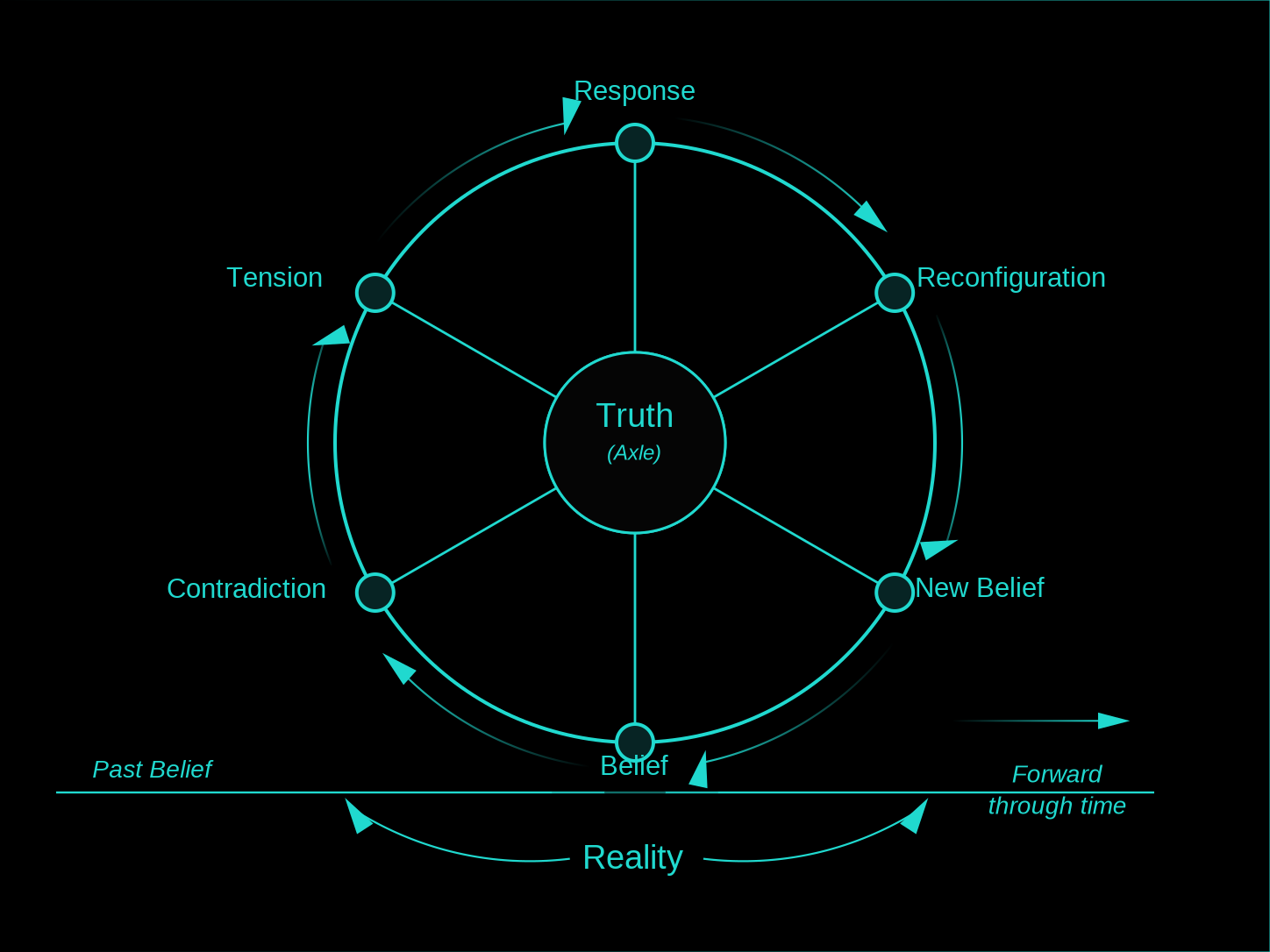
- Truth as the axle — the still center, the structural reference point
- The six stages as spokes around the rim: Belief, Contradiction, Tension, Response, Reconfiguration, New Belief.
- The rim as lived experience / the current working worldview — the part that keeps moving
- Rotation as change through time —- the cycle continuing rather than ending
- The point of contact with the ground as present encounter with reality — the specific place where abstraction meets what is
At its core, a vision of change begins with an acknowledgement that the current state is not the only possible state. This realization can be a powerful catalyst, driving individuals to question established norms and imagine alternatives. Whether focused on social justice, technological innovation, environmental sustainability, or political reform, these visions propose a departure from the status quo. They are not merely idle dreams; they are active intellectual and moral constructs that articulate a better reality and inspire action to achieve it.
Alignment
The power of a shared vision to mobilize collective action cannot be overstated. When a vision resonates with the experiences and aspirations of many, it can ignite movements, shape policies, and redirect the course of history. Figures throughout history—from civil rights leaders advocating for equality to scientists pursuing groundbreaking discoveries—have leveraged compelling visions to rally support and effect profound transformations.
However, visions of change are not without their complexities and challenges. The path to realizing a grand vision often involves navigating resistance from those who benefit from the existing order or who fear the uncertainties of a new one. Furthermore, different visions can clash, leading to conflicts over the “correct” or most desirable future. The process of change is often iterative, requiring adaptability and a willingness to refine the original vision in light of new information and unforeseen obstacles.
Ultimately, visions of change are essential to human advancement. They are the narratives we tell ourselves about where we want to go and who we want to be. They remind us that the future is not a predetermined destination, but a landscape we actively shape through our imaginations, our aspirations, and our sustained efforts to turn these visions into reality.
Similarity Across Scales
- Individual — holding new insights provisionally with epistemic humility
- Relational — sharing emerging realizations with partners without imposing dogmatism
- Institutional — creating adaptable systems using current breakthroughs while eyeing the future
- Societal — acknowledging that today’s truths become tomorrow’s history
Relationship to Other Ideas Within Fractegrity
- The Wheel of Beliefs / Axle of Truth — keeps the wheel rotating smoothly against reality
- Epistemic Humility / Permeability — ensures beliefs stay permeable to new evidence
- Beyond the Known Map / Threshold — navigates future horizons without false certainty
Next Threads to Pull:
Why Should I Care About the Future?
Inspires long-term thinking and intergenerational stewardship in a short-sighted world.
Belief Perseverance, Cognitive Rigidity, and the Wheel of Beliefs
Examines how hyper-rigid cognitive filters lead to belief perseverance and defensive blind spots under stress.
Why Should I Care About Change?
Examines why embracing change as informational signal unlocks resilience and continuous growth.
Visions gather aspirational works that express humanity’s potential for integrity, serving as reflections that bridge inner truth with collective destiny rather than fixed conclusions. Fractegrity’s Wheel uses seven lenses—patterns, integrity, responsibility, resonance, balance, change, and beyond—to examine how belief changes across scale and context. Belief operates from the personal to the societal, with integrity at the center and progression through groups, institutions, and culture shaping lived experience. A vision that resonates can mobilize collective action, influence policy, and drive transformative change, though it must navigate resistance and ongoing refinement.